














Chapter 1: Definition of Bhakti
Swami Vivekananda's works are in the public domain. This is due to the following reasons:
- Copyright Expiration
- Author's Death: Swami Vivekananda passed away in 1902.
- Public Domain Criteria: Works by authors who died more than 100 years ago are generally in the public domain.
- Global Public Domain
- United States: The work is in the public domain in the U.S. because it was published before 1923 and did not comply with U.S. copyright formalities.
- India: Under Indian copyright law, works enter the public domain 60 years after the author's death, which applies here.
Visit the Download section to download this book and other books in PDF format.
Prayer
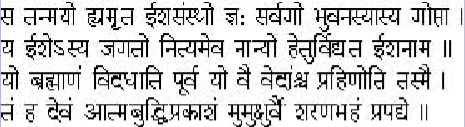
He is the Soul of the Universe; He is Immortal; His is the Rulership; He is the All–knowing, the
All–pervading, the Protector of the Universe, the Eternal Ruler. None else is there efficient to govern the world
eternally. He who at the beginning of creation projected Brahmâ (i.e. the universal consciousness), and who delivered
the Vedas unto him — seeking liberation I go for refuge unto that effulgent One, whose light turns the understanding
towards the Âtman.
— Shvetâshvatara–Upanishad, VI. 17–18.
Definition of Bhakti
Bhakti–Yoga is a real, genuine search after the Lord, a search beginning, continuing, and ending in love. One single moment of the madness of extreme love to God brings us eternal freedom. Bhakti
, says Nârada in his explanation of the Bhakti–aphorisms, is intense love to God
; When a man gets it, he loves all, hates none; he becomes satisfied for ever; This love cannot be reduced to any earthly benefit
, because so long as worldly desires last, that kind of love does not come; Bhakti is greater than karma, greater than Yoga, because these are intended for an object in view, while Bhakti is its own fruition, its own means and its own end.
Bhakti has been the one constant theme of our sages. Apart from the special writers on Bhakti, such as Shândilya* or Narada†, the great commentators on the Vyâsa–Sutras, evidently advocates of knowledge (Jnâna), have also something very suggestive to say about love. Even when the commentator is anxious to explain many, if not all, of the texts so as to make them import a sort of dry knowledge, the Sutras, in the chapter on worship especially, do not lend themselves to be easily manipulated in that fashion. There is not really so much difference between knowledge (Jnana) and love (Bhakti) as people sometimes imagine. We shall see, as we go on, that in the end they converge and meet at the same point. So also is it with Râja–Yoga, which when pursued as a means to attain liberation, and not (as unfortunately it frequently becomes in the hands of charlatans and mystery–mongers) as an instrument to hoodwink the unwary, leads us also to the same goal. The one great advantage of Bhakti is that it is the easiest and the most natural way to reach the great divine end in view; its great disadvantage is that in its lower forms it oftentimes degenerates into hideous fanaticism. The fanatical crew in Hinduism, or Mohammedanism, or Christianity, have always been almost exclusively recruited from these worshippers on the lower planes of Bhakti. That singleness of attachment (Nishthâ) to a loved object, without which no genuine love can grow, is very often also the cause of the denunciation of everything else. All the weak and undeveloped minds in every religion or country have only one way of loving their own ideal, i.e. by hating every other ideal. Herein is the explanation of why the same man who is so lovingly attached to his own ideal of God, so devoted to his own ideal of religion, becomes a howling fanatic as soon as he sees or hears anything of any other ideal. This kind of love is somewhat like the canine instinct of guarding the master's property from intrusion; only, the instinct of the dog is better than the reason of man, for the dog never mistakes its master for an enemy in whatever dress he may come before it. Again, the fanatic loses all power of judgment. Personal considerations are in his case of such absorbing interest that to him it is no question at all what a man says — whether it is right or wrong; but the one thing he is always particularly careful to know is who says it. The same man who is kind, good, honest, and loving to people of his own opinion, will not hesitate to do the vilest deeds when they are directed against persons beyond the pale of his own religious brotherhood.
* Shândilya refers to a Hindu sage known for his teachings of the Bhakti Sûtras which emphasize a path of love and devotion to God.
† Narada is a sage in Hindu mythology. He is known for being a divine messenger and storyteller and if often depicted as a musician who travels between different realms.

But this danger exists only in that stage of Bhakti which is called the preparatory (Gauni). When Bhakti has become ripe and has passed into that form which is called the supreme (Parâ), no more is there any fear of these hideous manifestations of fanaticism; that soul which is overpowered by this higher form of Bhakti is too near the God of Love to become an instrument for the diffusion of hatred.
It is not given to all of us to be harmonious in the building up of our characters in this life: yet we know that that character is of the noblest type in which all these three — knowledge and love and Yoga — are harmoniously fused. Three things are necessary for a bird to fly — the two wings and the tail as a rudder for steering. Jnana (Knowledge) is the one wing, Bhakti (Love) is the other, and Yoga is the tail that keeps up the balance. For those who cannot pursue all these three forms of worship together in harmony and take up, therefore, Bhakti alone as their way, it is necessary always to remember that forms and ceremonials, though absolutely necessary for the progressive soul, have no other value than taking us on to that state in which we feel the most intense love to God.

There is a little difference in opinion between the teachers of knowledge and those of love, though both admit the power of Bhakti. The Jnanis hold Bhakti to be an instrument of liberation, the Bhaktas look upon it both as the instrument and the thing to be attained. To my mind this is a distinction without much difference. In fact, Bhakti, when used as an instrument, really means a lower form of worship, and the higher form becomes inseparable from the lower form of realisation at a later stage. Each seems to lay a great stress upon his own peculiar method of worship, forgetting that with perfect love true knowledge is bound to come even unsought, and that from perfect knowledge true love is inseparable.
Bearing this in mind let us try to understand what the great Vedantic commentators have to say on the subject. In explaining the Sutra Âvrittirasakridupadeshât (Meditation is necessary, that having been often enjoined.), Bhagavân Shankara says, Thus people say, 'He is devoted to the king, he is devoted to the Guru'; they say this of him who follows his Guru, and does so, having that following as the one end in view. Similarly they say, 'The loving wife meditates on her loving husband'; here also a kind of eager and continuous remembrance is meant.
This is devotion according to Shankara.
Meditation again is a constant remembrance (of the thing meditated upon) flowing like an unbroken stream of oil poured out from one vessel to another. When this kind of remembering has been attained (in relation to God) all bandages break. Thus it is spoken of in the scriptures regarding constant remembering as a means to liberation. This remembering again is of the same form as seeing, because it is of the same meaning as in the passage, 'When He who is far and near is seen, the bonds of the heart are broken, all doubts vanish, and all effects of work disappear' He who is near can be seen, but he who is far
can only be remembered. Nevertheless the scripture says that he have to see Him who is near as well as Him who, is far, thereby indicating to us that the above kind of remembering is as good as seeing. This remembrance when exalted assumes the same form as seeing… Worship is constant remembering as may be seen from the essential texts of scriptures. Knowing, which is the same as repeated worship, has been described as constant remembering… Thus the memory, which has attained to the height of what is as good as direct perception, is spoken of in the Shruti as a means of liberation. 'This Atman is not to be reached through various sciences, nor by intellect, nor by much study of the Vedas. Whomsoever this Atman desires, by him is the Atman attained, unto him this Atman discovers Himself.' Here, after saying that mere hearing, thinking and meditating are not the means of attaining this Atman, it is said, 'Whom this Atman desires, by him the Atman is attained.' The extremely beloved is desired; by whomsoever this Atman is extremely beloved, he becomes the most beloved of the Atman. So that this beloved may attain the Atman, the Lord Himself helps. For it has been said by the Lord: 'Those who are constantly attached to Me and worship Me with love — I give that direction to their will by which they come to Me.' Therefore it is said that, to whomsoever this remembering, which is of the same form as direct perception, is very dear, because it is dear to the Object of such memory perception, he is desired by the Supreme Atman, by him the Supreme Atman is attained. This constant remembrance is denoted by the word Bhakti.
So says Bhagavân Râmânuja* in his commentary on the Sutra Athâto Brahma–jijnâsâ (Hence follows a dissertation on Brahman.)
* Bhagavân Râmânuja (1077 – 1157), also known as Ramanujacharya, was a prominent Indian Hindu philosopher. He is best known for his teachings on Vishishtadvaita, a philosophy of qualified non–dualism, and for his influence on the Bhakti movement in Hinduism.
In commenting on the Sutra of Patanjali, Ishvara pranidhânâdvâ*, i.e. Or by the worship of the Supreme Lord
— Bhoja says, Pranidhâna is that sort of Bhakti in which, without seeking results, such as sense–enjoyments etc., all works are dedicated to that Teacher of teachers.
Bhagavan Vyâsa† also, when commenting on the same, defines Pranidhana as the form of Bhakti by which the mercy of the Supreme Lord comes to the Yogi, and blesses him by granting him his desires
. According to Shândilya, Bhakti is intense love to God.
The best definition is, however, that given by the king of Bhaktas, Prahlâda‡:
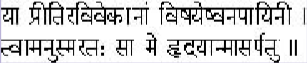
That deathless love which the ignorant have for the fleeting objects of the senses — as I keep meditating on Thee — may not that love slip away from my heart!
Love! For whom? For the Supreme Lord Ishvara. Love for any other
being, however great cannot be Bhakti; for, as Ramanuja says in his Shri Bhâshya, quoting an ancient Âchârya, i.e. a great teacher:
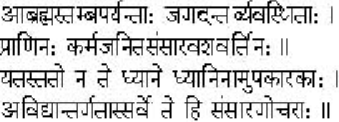
From Brahmâ to a clump of grass, all things that live in the world are slaves of birth and death caused by Karma; therefore they cannot be helpful as objects of meditation, because they are all in ignorance and subject to change.
In
commenting on the word Anurakti used by Shandilya, the commentator Svapneshvara says that it means Anu, after, and Rakti, attachment; i.e. the attachment which comes after the knowledge of the nature and glory of God; else a blind attachment to any one, e.g. to wife or children, would be Bhakti. We plainly see, therefore, that Bhakti is a series or succession of mental efforts at religious realisation beginning with ordinary worship and ending in a supreme intensity of love for Ishvara⹋.
* Ishvara pranidhânâdvâ, as mentioned in the Sutra of Patanjali, refers to surrendering to a higher power or divine consciousness. This helps students achieve a state of samadhi or liberation. The emphasis is on letting go of the ego and trusting in a greater force guiding one's life.
† Bhagavan Vyâsa, also known as Veda Vyasa or Krishna Dvaipayana, is a revered sage that is credited with composing the Mahabharata, which includes the Bhagavad Gita. He is said to have organized the Vedas into four parts. He is known for embodying wisdom and knowledge.
‡ Prahlâda is a character from Hindu mythology. He is known as a devoted prince of the asuras who worshipped Vishnu despite his father's opposition. Themes of devotion and the triumph of good over evil are constant. Even while while father attempted to kill him, these themes continue.
⹋ Ishvara means personal God or supreme being.

Chapters
| Bhakti Yoga: DefinitionBhakti Narada karma raja Shandilya Vyasa Sutras jnana gnana love hinduism christians Mohammedanism muslims islam christianity Nishtha gauni prepatory Sutra avrittirasakridupadeshat Bhagavan Shankara Shruti atman liberation vedas Sutra of Patanjali Ishvara pranidhanadva supreme atman Brahman |
The Real Yoga
website is designed to be a self–study website. But, feel free
to send us a message — but do make sure your email is correct.