















Chapter 8: Worship of Substitutes and Images
Bhakti Yoga
by Swami Vivekananda (1894)
Swami Vivekananda's works are in the public domain. This is due to the following reasons:
- Copyright Expiration
- Author's Death: Swami Vivekananda passed away in 1902.
- Public Domain Criteria: Works by authors who died more than 100 years ago are generally in the public domain.
- Global Public Domain
- United States: The work is in the public domain in the U.S. because it was published before 1923 and did not comply with U.S. copyright formalities.
- India: Under Indian copyright law, works enter the public domain 60 years after the author's death, which applies here.
Visit the Download section to download this book and other books in PDF format.
The next points to be considered are the worship of Pratikas* or of things more or less satisfactory as substitutes for God, and the worship of Pratimâs† or images. What is the worship of God through a Pratika?
It is अब्रह्मणि ब्रह्मदृष्ट्यऽनुसन्धानम्
* Pratikas means symbols, representations, or substitutes used to stand for something higher or abstract, especially in spiritual or religious practice.
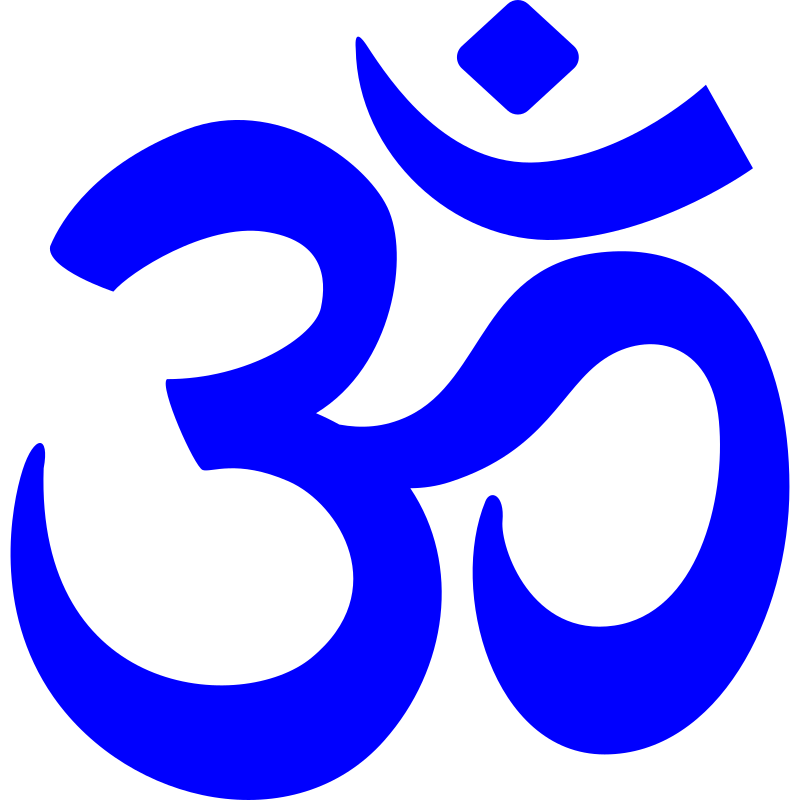
A Pratika is a physical object or symbol used to help focus the mind on the divine. It is not necessarily considered the ultimate reality itself, but a representation that points toward it. Even the Om is an example of a Pratika.
† Pratimâs means images, idols, or physical representations of a deity used in worship. The Sanskrit word Pratimā literally means: image, likeness, statue, idol. It refers specifically to a crafted form meant to represent a divine being.
Examples include statues of: Shiva, Vishnu, Durga, Ganesha. These images serve as a visible focus for devotion and ritual.
The difference between Pratikas and Pratimâs are:
- Pratikas = symbolic objects representing the divine (sun, fire, sacred symbols).
- Pratimâs = actual sculpted images or idols of deities.
— Joining the mind with devotion to that which is not Brahman, taking it to be Brahman
— says Bhagavân Râmânuja*. Worship the mind as Brahman this is internal; and the Âkâsha as Brahman, this is with regard to the Devas
, says Shankara†. The mind is an internal Pratika, the Akasha is an external one, and both have to be worshipped as substitutes of God. He continues, Similarly — 'the Sun is Brahman, this is the command', 'He who worships Name as Brahman' — in all such passages the doubt arises as to the worship of Pratikas.
The word Pratika means going towards; and worshipping a Pratika is worshipping something as a substitute which is, in some one or more respects, like Brahman more and more, but is not Brahman. Along with the Pratikas mentioned in the Shrutis there are various others to be found in the Purânas and the Tantras. In this kind of Pratika–worship may be included all the various forms of Pitri–worship and Deva–worship.
* Bhagavân Râmânuja (c. 1017–1137 CE) was one of the most important philosophers and theologians in the tradition of Hinduism, especially within the Vaishnavism tradition. He is best known for developing the philosophical school called Vishishtadvaita (Qualified Non–Dualism). Râmânuja strongly promoted devotion (Bhakti) as the main path to liberation.
Râmânuja taught that:
- There is one ultimate reality, Vishnu (or Narayana).
- Individual souls and the universe are real, not illusions.
- They exist within God as His attributes or body.
This view is called
qualified non–dualismbecause God is one, but the souls and the world are real parts of that unity.This differed from the strict non–dualism of Adi Shankaracharya, who taught Advaita Vedanta, where the world is ultimately considered an illusion (Maya).
† Shankara, also called Adi Shankaracharya (c. 8th century CE), was one of the most influential philosophers and spiritual teachers in Hinduism. He is famous for consolidating and explaining the philosophy of Advaita Vedanta, which teaches non–dualism — the idea that ultimate reality is one without a second.
Shankara taught that:
- The only ultimate reality is Brahman (the infinite, absolute consciousness).
- The individual self (Atman) is identical with Brahman.
- The world as we experience it is not absolutely real, but appears real because of Maya (cosmic illusion or ignorance).
His famous teaching can be summarized as:
Brahman alone is real; the world is appearance; the individual self is not different from Brahman.
Now worshipping Ishvara and Him alone is Bhakti; the worship of anything else — Deva*, or Pitri†, or any other being — cannot be Bhakti. The various kinds of worship of the various Devas are all to be included in ritualistic Karma, which gives to the worshipper only a particular result in the form of some celestial enjoyment, but can neither give rise to Bhakti nor lead to Mukti‡. One thing, therefore, has to be carefully borne in mind. If, as it may happen in some cases, the highly philosophic ideal, the supreme Brahman, is dragged down by Pratika–worship to the level of the Pratika, and the Pratika itself is taken to be the Atman of the worshipper or his Antaryâmin (Inner Ruler), the worshipper gets entirely misled, as no Pratika can really be the Atman of the worshipper.
* Deva means
God,divine being, orshining one.† Pitri means
ancestororforefather, especially the departed ancestors who are honored after death.‡ Mukti is a step toward liberation or release from birth and death. It is a temporary or conditional state whereas Moksha is the final, ultimate liberation — complete freedom from the cycle of rebirth.
But where Brahman Himself is the object of worship, and the Pratika stands only as a substitute or a suggestion thereof, that is to say, where, through the Pratika the omnipresent Brahman is worshipped — the Pratika itself being idealised into the cause of all, Brahman — the worship is positively beneficial; nay, it is absolutely necessary for all mankind until they have all got beyond the primary or preparatory state of the mind in regard to worship. When, therefore, any gods or other beings are worshipped in and for themselves, such worship is only a ritualistic Karma; and as a Vidyâ (science) it gives us only the fruit belonging to that particular Vidya; but when the Devas or any other beings are looked upon as Brahman and worshipped, the result obtained is the same as by the worshipping of Ishvara. This explains how, in many cases, both in the Shrutis* and the Smritis‡, a god, or a sage, or some other extraordinary being is taken up and lifted, as it were, out of his own nature and idealised into Brahman, and is then worshipped. Says the Advaitin, Is not everything Brahman when the name and the form have been removed from it?
Is not He, the Lord, the innermost Self of every one?
says the Vishishtâdvaitin‡.
* Shrutis or Śruti means
that which is heard. Considered divinely revealed to sages.‡ Smriti means
that which is remembered. Written by humans based on tradition.Examples of Śruti includes: Vedas, Upanishads, Brahmanas, Aranyakas.
Examples of Smriti includes: Manusmriti, Ramayana, Mahabharata, Puranas, Agamas.
‡ A Vishishtâdvaitin is a follower of Vishishtadvaita, which is the
qualified non–dualismschool of Vedanta philosophy founded by Ramanuja.
फलम् आदित्याद्यपासनेषु ब्रह्मैव दास्यति सर्वाध्यक्षत्वात्
— The fruition of even the worship of Adityas etc. Brahman Himself bestows, because He is the Ruler of all.
Says Shankara in his Brahma–Sutra–Bhâsya*
* Brahma–Sutra–Bhâsya can be summarized by saying
Brahman alone is real; the world is illusion; knowing this leads to liberation.
ईदृशं चात्र ब्रह्मण उपास्यत्वं यतः प्रतीकेषु तत्दृष्ट्याध्यारोपणं प्रतिमादिषु इव विष्ण्वादीनाम्।
Here in this way does Brahman become the object of worship, because He, as Brahman, is superimposed on the Pratikas, just as Vishnu etc. are superimposed upon images etc.
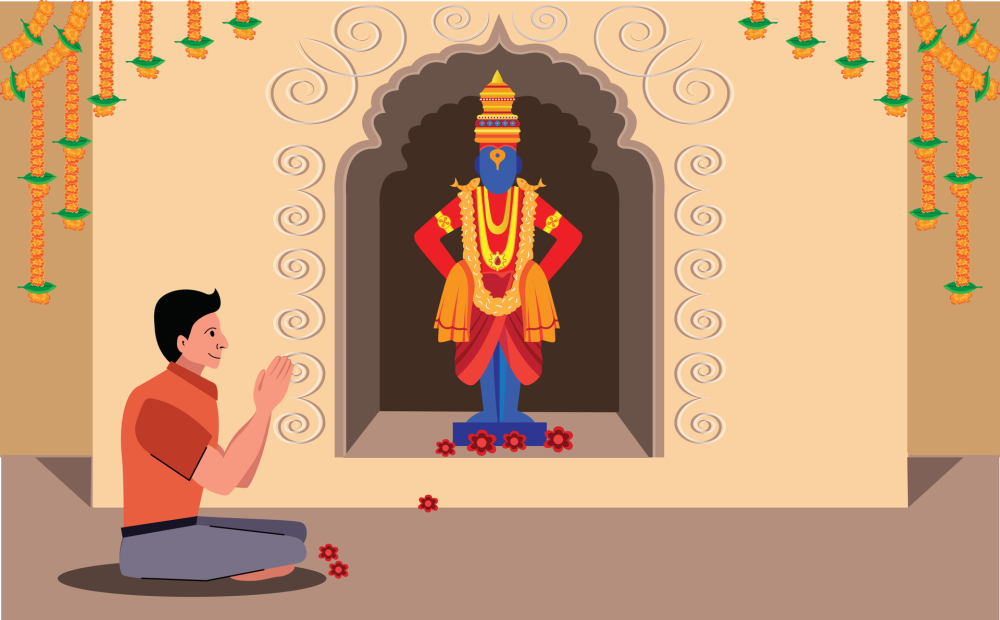
The same ideas apply to the worship of the Pratimas as to that of the Pratikas; that is to say, if the image stands for a god or a saint, the worship is not the result of Bhakti, and does not lead lo liberation; but if it stands for the one God, the worship thereof will bring both Bhakti and Mukti. Of the principal religions of the world we see Vedantism, Buddhism, and certain forms of Christianity freely using images; only two religions, Mohammedanism and Protestantism, refuse such help. Yet the Mohammedans use the grave of their saints and martyrs almost in the place of images; and the Protestants, in rejecting all concrete helps to religion, are drifting away every year farther and farther from spirituality till at present there is scarcely any difference between the advanced Protestants and the followers of August Comte, or agnostics who preach ethics alone. Again, in Christianity and Mohammedanism whatever exists of image worship is made to fall under that category in which the Pratika or the Pratima is worshipped in itself, but not as a help to the vision
(Drishtisaukaryam*) of God; therefore it is at best only of the nature of ritualistic Karmas and cannot produce either Bhakti or Mukti. In this form of image–worship, the allegiance of the soul is given to other things than Ishvara, and, therefore, such use of images, or graves, or temples, or tombs, is real idolatry; it is in itself neither sinful nor wicked — it is a rite — a Karma, and worshippers must and will get the fruit thereof.
* Drishtisaukaryam is a philosophical concept in Vedanta that refers to the perfection or completeness of perception — the state where the mind sees everything as it truly is.
Drishtisaukaryam describes the clarity of knowledge attained when the mind fully grasps Brahman, the ultimate reality.
Chapter Summmary
Sometimes following the meaning or purpose of a chapter like this can be difficult, especially for a Westerner, who isn't used to the various Sanskrit words and/or sages being mentioned.
Therefore, the quick summary or this chapter is, or could be, as follows:
- Humans use symbols and idols (Pratikas and Pratimās) to focus their minds on the divine.
- This is done because grasping the infinite is difficult to grasp directly.
- These images are tools for devotion and concentration, not God itself.
- The ultimate goal is to transcend the symbols and realize the infinite reality (Brahman).
The following table gives examples of Pratika:
| Sun (Surya) | Symbol of ultimate light, consciousness. |
| Fire (Agni) | Purity, transformation, divine energy. |
| Om (ॐ) | Cosmic sound–symbol of Brahman. |
| Lotus Flower (Padma) | Spiritual awakening, purity. |
| Conch (Shankha) | Auspiciousness, spreading divine vibration. |
| Swastika | Harmony, prosperity, well–being. |
| Water (Jala) | Purity, life, fluidity of the cosmos. |
| Cow (Gau) | Fertility, abundance, sacredness. |
| Dharma Wheel (Dharmachakra) | Wheel of righteousness. |
The following table gives examples of Pratima:
| Vishnu Murti | Statue or image of Vishnu/Narayana. |
| Durga Idol | Form of goddess Durga for worship. |
| Kali Idol | Form of goddess Kali for devotion. |
| Ganesha Statue | Remover of obstacles, beginner of rituals. |
| Krishna or Rama Murti | Devotional focus on specific avatars of Vishnu. |
| Hanuman Murti | Symbol of devotion, strength, and service. |
| Buddha | Statue or image of the Buddha. |
— Yogi Karmananda
Chapters
| Gauni (Preparation): DefinitionBhakti Narada karma raja Shandilya Vyasa Sutras jnana gnana love hinduism christians Mohammedanism muslims islam christianity Nishtha gauni prepatory Sutra avrittirasakridupadeshat Bhagavan Shankara Shruti atman liberation vedas Sutra of Patanjali Ishvara pranidhanadva supreme atman Brahman |
| Gauni (Preparation): IshvaraIshvara satchitananda sat chit ananda Brahman Absolute Reality Sutras pada Moksha Jiva aphorism Kshatras Varuna Soma Rudra Parjanya Yama Mrityu Ishâna Atman Ramanuja Advaita brahman not this not this Shrutis Sankhyas Samkhyas Bhagavata Purana Prahlada gopis krishna Acharya Shankara Vyasa Varaha Purana Madhvacharya |
| Gauni (Preparation): Spiritual Realisationbhakti bhakta realization realisation god moksha gauni para Ishtapurta |
| Gauni (Preparation): The Need of Guruguru spiritual Shishya student teacher fools blind leading the blind |
| Gauni (Preparation): Qualifications of the Aspirant and the Teacherguru teacher sun purity bible vedas koran Bhagavân Ramakrishna mango bhakta mango leaves counting twigs Shantih shanti sine qua non sin religion Himalayas the Alps the Caucasus Tibet gobi |
| Gauni (Preparation): Incarnate Teachers and IncarnationShri Krishna Bhagavata omnipotence omnipresence Avataras of Ishvara Paramahamsa buffalo fish Bhagavan Shri Ramakrishna Paramahamsa big talker man on the street |
| Gauni (Preparation): The Mantra: Om: Word and Wisdommantra Chittavritti nama rupa name and form Sphota Brahma Hiranyagarbha Mahat om aum krishna Akhanda-Sachchidânanda Tattvas |
| Gauni (Preparation): Worship of Substitutes and ImagesPratikas Pratimas Brahman Bhagavan Ramanuja akasha Devas Shankara Karma omnipresent Vidya Ishvara Shrutis Smritis Vishishtâdvaitin Adityas Brahma Sutra Bhasya Vedantism Buddhism Christianity islam Mohammedans Protestantism agnostics August Comte Drishtisaukaryam |
Send Message
The Real Yoga
website is designed to be a self–study website. But, feel free
to send us a message — but do make sure your email is correct.
Respecting Your Privacy
No spying. No cookies. No Google. No advertising. No tracking. No joking — well, maybe a few jokes.
Say yes to 100% free! Two thumbs up!










Love Requires No Effort