












Chapter 1 वेद: The Gospel
The Holy Science
कैवल्यदर्शनम्
by Jnanavatar Swami Sri Yukteswar Giri (1894).
In this book, Swami Yukteswar helps us see the unity among different religions and that all truths are but one truth. This is a must read for all those interested in Yoga.
Due to its original publication date in 1894, which places it outside of the copyright period for most
works, The Holy Science
is in the public domain.
Sutra 1
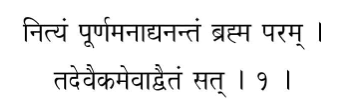
Parambrahma (Spirit or God) is everlasting, complete, without beginning or end. It is one, indivisible Being.*
* Swami Sri Yukteswarji stated these sutras (precepts) in Sanskrit only, as shown. The translation has been provided by Self–Realization Fellowship. (Publisher's Note)
The Eternal Father, God, Swami Parambrahma, is the only Real Substance, Sat, and is all in all in the universe.
Why God is not comprehensible. Man possesses eternal faith and believes intuitively in the existence of a Substance, of which the objects of sense—sound, touch, sight, taste, and smell, the component parts of this visible world—are but properties. As man identifies himself with his material body, composed of the aforesaid properties, he is able to comprehend by these imperfect organs these properties only, and not the Substance to which these properties belong. The Eternal Father, God, the only Substance in the universe, is therefore not comprehensible by man of this material world, unless he becomes divine by lifting his self above this creation of Darkness or Maya. See Hebrews 11:1 and John 8:28.
Now faith is the substance of things hoped for, the evidence of things not seen.
Then said Jesus unto them, When ye have lifted up the son of man, then shall ye know that I am he.
Sutra 2

In It (Parambrahma) is the origin of all knowledge and love, the root of all power and joy.
Prakriti or Nature of God. The Almighty Force, Shakti, or in other words the Eternal Joy, Ananda, which produces the world; and the Omniscient Feeling, Chit, which makes this world conscious, demonstrate the Nature, Prakriti, of God the Father.
How God is comprehended. As man is the likeness of God, directing his attention inward he can comprehend within him the said Force and Feeling, the sole properties of his Self—the Force Almighty as his will, Vasana, with enjoyment, Bhoga; and the Feeling Omniscient as his Consciousness, Chetana, that enjoys, Bhokta. See Genesis 1:27.
So God created man in his own image, in the image of God created he him; male and female created he them.
Sutra 3
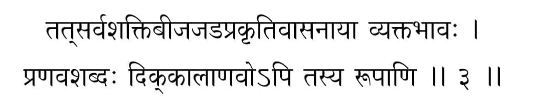
Parambrahma causes creation, inert Nature (Prakriti), to emerge. From Aum (Pranava, the Word, the manifestation of the Omnipotent Force), come Kala, Time; Desa, Space; and Anu, the Atom (the vibratory structure of creation).
The Word, Amen (Aum), is the beginning of the Creation. The manifestation of Omnipotent Force (the Repulsion and its complementary expression, Omniscient Feeling or Love, the Attraction) is vibration, which appears as a peculiar sound: the Word, Amen, Aum. In its different aspects Aum presents the idea of change, which is Time, Kala, in the Ever–Unchangeable; and the idea of division, which is Space, Desa, in the Ever–Indivisible.
The Four Ideas: the Word, Time, Space, and the Atom. The ensuing effect is the idea of particles— the innumerable atoms, patra or anu. These four— the Word, Time, Space, and the Atom—are therefore one and the same, and substantially nothing but mere ideas.
This manifestation of the Word (becoming flesh, the external material) created this visible world. So the Word, Amen, Aum, being the manifestation of the Eternal Nature of the Almighty Father or His Own Self, is inseparable from and nothing but God Himself; as the burning power is inseparable from and nothing but the fire itself. See Revelation 3:14; John 1:1, 3, 14.
These things saith the Amen, the faithful and true witness, the beginning of the creation of God.
In the beginning was the Word, and the Word was with God, and the Word was God.… All things were made by him; and without him was not anything made that was made.… And the Word was made flesh and dwelt among us.
Sutra 4

The cause of creation is Anu or the Atoms. En masse they are called Maya or the Lord's illusory power; each individual Anu is called Avidya, Ignorance.
Atoms the throne of Spirit the Creator. These Atoms, which represent within and without the four ideas mentioned above, are the throne of Spirit, the Creator, which shining on them creates this universe. They are called en masse Maya, the Darkness, as they keep the Spiritual Light out of comprehension; and each of them separately is called
Avidya, the Ignorance, as it makes man ignorant even of his own Self. Hence the aforesaid four ideas which give rise to all those confusions are mentioned in the Bible as so many beasts. Man, so long as he identifies himself with his gross material body, holds a position far inferior to that of the primal fourfold Atom and necessarily fails to comprehend the same. But when he raises himself to the level thereof, he not only comprehends this Atom, both inside and outside, but also the whole creation, both unmanifested and manifested (i.e., before and behind
). See Revelation 4:6.
And in the midst of the throne, and round about the throne, were four beasts full of eyes before and behind.
Sutra 5
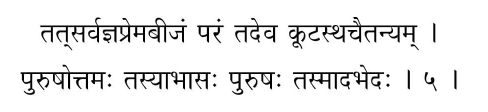
The Omniscient Love aspect of Parambrahma is Kutastha Chaitanya. The individual Self, being Its manifestation, is one with It.
Kutastha Chaitanya, the Holy Ghost, Purushottama. The manifestation of Premabijam Chit (Attraction, the Omniscient Love) is Life, the Omnipresent Holy Spirit, and is called the Holy Ghost, Kutastha Chaitanya or Purushottama, which shines on the Darkness, Maya, to attract every portion of it toward Divinity. But the Darkness, Maya, or its individual parts,* Avidya the Ignorance, being repulsion itself, cannot receive or comprehend the Spiritual Light, but reflects it.
* That is, its presence in each man.
Abhasa Chaitanya or Purusha, the Sons of God. This Holy Ghost, being the manifestation of the Omniscient Nature of the Eternal Father, God, is no other substance than God Himself; and so these reflections of spiritual rays are called the Sons of God— Abhasa Chaitanya or Purusha. See John 1:4, 5, 11.
In him was life; and the life was the light of men.
And the light shineth in darkness; and the darkness comprehended it not.
He came unto his own, and his own received him not.
Sutra 6
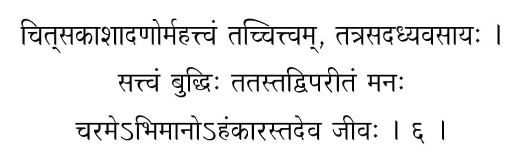
The Atom, under the influence of Chit (universal knowledge) forms the Chitta or the calm state of mind, which when spiritualized is called Buddhi, Intelligence. Its opposite is Manas, Mind, in which lives the Jiva: the self with Ahamkara, Ego, the idea of separate existence.
Chitta, the Heart; Ahamkara, Ego, the son of man. This Atom, Avidya, the Ignorance, being under the influence of Universal Love, Chit, the Holy Spirit, becomes spiritualized, like iron filings in a magnetic aura, and possessed of consciousness, the power of feeling, when it is called Mahat, the Heart, Chitta; and being such, the idea of separate existence of self appears in it, which is called Ahamkara, Ego, the son of man.
Buddhi, the Intelligence; Manas, the Mind. Being thus magnetized, it has two poles, one of which attracts it toward the Real Substance, Sat, and the other repels it from the same. The former is called Sattva or Buddhi, the Intelligence, which determines what is Truth; and the latter, being a particle of Repulsion, the Almighty Force spiritualized as aforesaid, produces the ideal world for enjoyment (ananda) and is called Anandatwa or Manas, the Mind.
Sutra 7 — 10
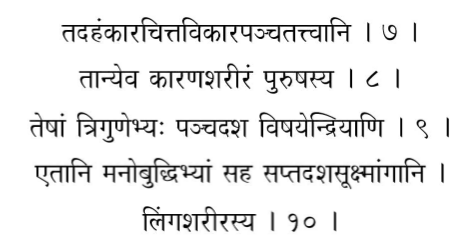
Chitta, the spiritualized Atom, in which Ahamkara (the idea of separate existence of Self) appears, has five manifestations (aura electricities).
They (the five aura electricities) constitute the causal body of Purusha.
The five electricities, Pancha Tattwa, from their three attributes, Gunas—Sattva (positive), Rajas (neutralizing), and Tamas (negative)—produce Jnanendriyas (organs of sense), Karmendriyas (organs of action), and Tanmatras (objects of sense).
These fifteen attributes plus Mind and Intelligence constitute the seventeen fine limbs
of the
subtle body, the Lingasarira.
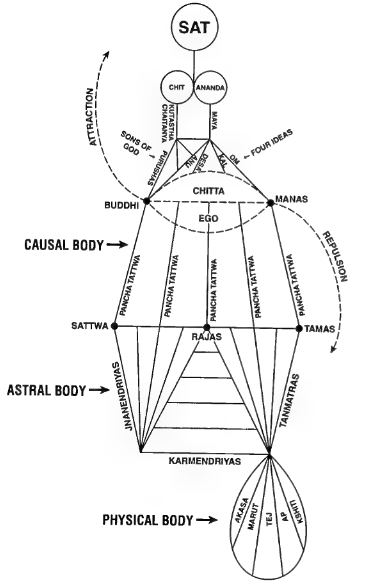
Pancha Tattwa, the Root–Causes of creation, are the causal body. This spiritualized Atom, Chitta (the Heart), being the Repulsion manifested, produces five sorts of aura electricities from its five different parts: one from the middle, two from the two extremities, and the other two from the spaces intervening between the middle and each of the extremities. These five sorts of electricities, being attracted under the influence of Universal Love (the Holy Ghost) toward the Real Substance, Sat, produce a magnetic field which is called the body of Sattva Buddhi, the Intelligence. These five electricities being the causes of all other creations are called Pancha Tattwa, the five Root–Causes, and are considered the causal body of Purusha, the Son of God.
Three Gunas, the electric attributes. The electricities, being evolved from the polarized Chitta, are also in a polarized state and are endowed with its three attributes or Gunas: Sattva the positive, Tamas the negative, and Rajas the neutralizing.
Karmendriyas, the five organs of action. The neutralizing attributes of the five electricities are Karmendriyas, the organs of action—excretion, generation, motion (feet), manual skill (hands), and speech. These organs, being the manifestation of the neutralizing energy of the spiritualized Atom, Chitta (the Heart), constitute an energetic body, called the body of energy, the life force or Prana.
Vishaya or Tanmatras, the five objects of the senses. The negative attributes of the five electricities are the five Tanmatras or objects of the senses of smell, taste, sight, touch, and sound, which, being united with the organs of sense through the neutralizing power of the organs of action, satisfy the desires of the heart.
Lingasarira, the fine material body. These fifteen attributes with two poles—Mind and Intelligence—of the spiritualized Atom constitute Lingasarira or Sukshmasarira, the fine material body of Purusha, the Son of God.
Sutra 11, 12
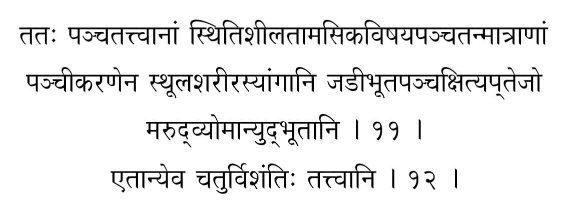
The aforesaid five objects, which are the negative attributes of the five electricities, being combined produce the idea of gross matter in its five forms: Kshiti, solids; Ap, liquids; Tejas, fire; Marut, gaseous substances; and Akasha, ether.
These five forms of gross matter and the aforesaid fifteen attributes, together with Manas, Mind, sense consciousness; Buddhi, discriminative Intelligence; Chitta, the Heart or power of feeling; and Ahamkara, the Ego, constitute the twenty–four basic principles of creation.
Gross material body. The aforesaid five objects, which are the negative attributes of the five electricities, being combined together produce the idea of gross matter which appears to us in five different varieties: Kshiti, the solid; Ap, the liquid; Tejas, the fiery; Marut, the gaseous; and Vyoma or Akasha, the ethereal. These constitute the outer covering called Sthulasarira, the gross material body of Purusha, the Son of God.
Twenty–four Elders. These five gross matters and the aforesaid fifteen attributes together with Manas, the Mind; Buddhi, the Intelligence; Chitta, the Heart; and Ahamkara, the Ego, constitute the twenty–four principles or Elders, as mentioned in the Bible. See Revelation 4:4.
And round about the throne were four and twenty seats; and upon the seats I saw four and twenty elders.
The aforesaid twenty–four principles, which completed the creation of Darkness, Maya, are nothing more than the development of Ignorance, Avidya; and as this Ignorance is composed only of ideas as mentioned above, creation has in reality no substantial existence, but is a mere play of ideas on the Eternal Substance, God the Father.
Sutra 13

This universe is differentiated into fourteen spheres, seven Swargas and seven Pataias.
Seven Spheres or Swargas. This universe thus described, commencing from the Eternal Substance, God, down to the gross material creation, has been distinguished into seven different spheres, Swargas or Lokas.
7th Sphere, Satyaloka. The foremost of these is Satyaloka, the sphere of God—the only Real Substance, Sat, in the universe. No name can describe it, nor can anything in the creation of Darkness or Light designate it. This sphere is therefore called Anama, the Nameless.
6th Sphere, Tapoloka. The next in order is Tapoloka, the sphere of the Holy Spirit which is the Eternal Patience, as it remains forever undisturbed by any limited idea. Because it is not approachable even by the Sons of God as such, it is called Agama, the Inaccessible.
5th Sphere, Janaloka. Next is Janaloka, the sphere of spiritual reflection, the Sons of God, wherein the idea of separate existence of Self originates. As this sphere is above the comprehension of anyone in the creation of Darkness, Maya, it is called Alakshya, the Incomprehensible.
4th Sphere, Maharloka.. Then comes Maharloka, the sphere of the Atom, the beginning of the creation of Darkness, Maya, upon which the Spirit is reflected. This, the connecting link, is the only way between the spiritual and the material creation and is called the Door, Dasamadwara.
3rd Sphere, Swarloka.. Around this Atom is Swarloka, the sphere of magnetic aura, the electricities. This sphere, being characterized by the absence of all the creation (even the organs and their objects, the fine material things), is called Mahasunya, the Great Vacuum.
2nd Sphere, Bhuvarloka.. The next is Bhuvarloka, the sphere of electric attributes. As the gross matters of the creation are entirely absent from this sphere, and it is conspicuous by the presence of the fine matters only, it is called Sunya, the Vacuum Ordinary.
1st Sphere, Bhuloka.. The last and lowest sphere is Bhuloka, the sphere of gross material creation, which is always visible to everyone.
Sapta Patalas, seven churches. As God created man in His own image, so is the body of man like unto the image of this universe. The material body of man has also seven vital places within it called Patalas. Man, turning toward his Self and advancing in the right way, perceives the Spiritual Light in these places, which are described in the Bible as so many churches; the lights like stars perceived therein are as so many angels. See Revelation 1:12, 13, 16, 20.
And being turned, I saw seven golden candlesticks, and in the midst of the seven candlesticks one like unto the son of man.…
And he had in his right hand seven stars…
The seven stars are the angels of the seven churches; and the seven candlesticks which thou sawest are the seven churches.
14 Bhuvanas, the stages of creation. The abovementioned seven spheres or Swargas and the seven Patalas constitute the fourteen Bhuvanas, the fourteen distinguishable stages of the creation.
Sutra 14

Purusha is covered by five koshas or sheaths.
5 Koshas or Sheaths. This Purusha, the Son of God is screened by five coverings called the koshas or sheaths.
Heart, the 1st Kosha. The first of these five is Heart, Chitta, the Atom, composed of four ideas as mentioned before, which feels or enjoys, and thus being the seat of bliss, ananda, is called Anandamaya Kosha.
Buddhi, the 2nd Kosha. The second is the magnetic–aura electricities, manifestations of Buddhi, the Intelligence that determines what is truth. Thus, being the seat of knowledge, jnana, it is called Jnanamaya Kosha.
Manas, the 3rd Kosha. The third is the body of Manas, the Mind, composed of the organs of senses, as mentioned above, and called the Manomaya Kosha.
Prana, the 4th Kosha. The fourth is the body of energy, life force or Prana, composed of the organs of action as described before, and thus called Pranamaya Kosha.
Gross matter, the 5th Kosha. The fifth and last of these sheaths is the gross matter, the Atom’s outer coating, which, becoming Anna, nourishment, supports this visible world and thus is called the Annamaya Kosha.
Action of Love. The action of Repulsion, the manifestation of the Omnipotent Energy, being thus completed, the action of Attraction (the Omnipotent Love in the core of the heart) begins to be manifested. Under the influence of this Omniscient Love, the Attraction, the Atoms, being attracted toward one another, come nearer and nearer, taking ethereal, gaseous, fiery, liquid, and solid forms.
Inanimate kingdom. Thus this visible world becomes adorned with suns, planets, and moons, which we call the inanimate kingdom of the creation.
Vegetable kingdom. In this manner, when the action of Divine Love becomes well developed, the evolution of Avidya, Ignorance (the particle of Darkness, Maya, the Omnipotent Energy manifested), begins to be withdrawn. Annamaya Kosha, the Atom’s outer coating of gross matter being thus withdrawn, Pranamaya Kosha (the sheath composed of Karmendriyas, the organs of action) begins to operate. In this organic state the Atoms, embracing each other more closely to their heart, appear as the vegetable kingdom in the creation.
Animal kingdom. When the Pranamaya Kosha becomes withdrawn, the Manomaya Kosha (the sheath composed of Jnanendriyas, the organs of sense) comes to light. The Atoms then perceive the nature of the external world and, attracting other Atoms of different nature, form bodies as necessary for enjoyment, and thus the animal kingdom appears in the creation.
Mankind. When Manomaya Kosha becomes withdrawn, Jnanamaya Kosha (the body of Intelligence composed of electricities) becomes perceptible. The Atom, acquiring the power of determining right and wrong, becomes man, the rational being in the creation.
Devata or Angel. When man, cultivating the Divine Spirit or Omniscient Love within his heart, is able to withdraw this Jnanamaya Kosha, then the innermost sheath, Chitta, the Heart (composed of four ideas), becomes manifest. Man is then called Devata or Angel in the creation.
Free, Sannyasi. When the Heart or innermost sheath is also withdrawn, there is no longer anything to keep man in bondage to this creation of Darkness, Maya. He then becomes free, Sannyasi, the Son of God, and enters into the creation of Light.
Sutra 15, 16

Just as the objects seen in our dreams are found, when we awake, to be insubstantial, so our waking perceptions are likewise unreal—a matter of inference only.
Sleeping and waking states. When man compares his ideas relating to gross matters conceived in the wakeful state with his conception of ideas in dream, the similarity existing between them naturally leads him to conclude that this external world also is not what it appears to be.
When he looks for further explanation, he finds that all his wakeful conceptions are substantially nothing but mere ideas caused by the union of five objects of sense (the negative attributes of the five internal electricities) with the five organs of sense (their positive attributes) through the medium of five organs of action (the neutralizing attributes of the electricities).
This union is effected by the operation of Mind (Manas) and conceived or grasped by the Intelligence (Buddhi). Thus it is clear that all conceptions which man forms in his wakeful state are mere inferential Parokshajnana—a matter of inference only.
Sutra 17

What is needed is a Guru, a Savior, who will awaken us to Bhakti (devotion) and to perceptions of Truth.
When man finds his Sat–Guru or Savior. In this way, when man understands by his Parokshajnana (correct inference) the nothingness of the external world, he appreciates the position of John the Baptist, the divine personage who witnessed Light and bore testimony of Christ, after his heart’s love, the heavenly gift of Nature, had become developed.
Any advanced sincere seeker may be fortunate in having the Godlike company of some one of such personages, who may kindly stand to him as his Spiritual Preceptor, Sat–Guru, the Savior. Following affectionately the holy precepts of these divine personages, man becomes able to direct all his organs of sense inward to their common center—the sensorium, Trikuti or Sushumnadwara, the door of the interior world—where he comprehends the Voice, like a peculiar knocking
sound, [the Cosmic Vibration that is] the Word, Amen, Aum; and sees the God–sent luminous body of Radha, symbolized in the Bible as the Forerunner orJohn the Baptist. See Revelation 3:14, 20 and John 1:6, 8, 23.
These things saith the Amen, the faithful and true witness, the beginning of the creation of God.… Behold, I stand at the door, and knock; if any man hear my voice and open the door, I will come in to him and will sup with him, and he with me.
There was a man sent from God, whose name was John.… He was not that Light, but was sent to bear witness of that Light.… He said, I am the voice of one crying in the wilderness, Make straight the way of the Lord.
Ganga, Yamuna, or Jordan, the holy streams. From the peculiar nature of this sound, issuing as it does like a stream from a higher unknown region and losing itself in the gross material creation, it is figuratively designated by various sects of people by the names of different rivers that they consider as sacred; for example, Ganga by the Hindus, Yamuna by the Vaishnavas*, and Jordan† by the Christians.
The 2nd birth. Through his luminous body, man, believing in the existence of the true Light—the Life of this universe—becomes baptized or absorbed in the holy stream of the sound. The baptism is, so to speak, the second birth of man and is called Bhakti Yoga‡, without which man can never comprehend the real internal world, the kingdom of God. See John 1:9 and 3:3.
* Worshipers of Vishnu, God as Preserver.
† Matthew 3:13–17.
‡ Union with God through Love, the Attraction, which is constantly drawing man toward the kingdom of God. (Publisher's Note)
That was the true Light, which lighteth every man that cometh into the world.
Verily, verily, I say unto thee, Except a man be born again, he cannot see the kingdom of God.
Aparokshajnana, the real comprehension. In this state the son of man begins to repent and, turning back from the gross material creation, creeps toward his Divinity, the Eternal Substance, God. When the developments of ignorance are stopped, man gradually comprehends the true character of this creation of Darkness, Maya, as a mere play of ideas of the Supreme Nature on His own Self, the only Real Substance. This true comprehension is called Aparokshajnana.
Sutra 18

Emancipation (Kaivalya) is obtained when one realizes the oneness of his Self with the Universal Self, the Supreme Reality.
Sannyasi or Christ the anointed Savior. When all the developments of Ignorance are withdrawn, the heart, being perfectly clear and purified, no longer merely reflects the Spiritual Light but actively manifests the same, and thus being consecrated and anointed, man becomes Sannyasi, free, or Christ the Savior*. See John 1:33.
* That is, he becomes one with Christ Consciousness, the reflected consciousness of the Eternal Father God in creation, immanent in the Word or Aum, the Cosmic Vibration. Thus is he freed or saved from the darkness of Maya, the delusion of separateness from the Father. (Publisher's Note)
Upon whom thou shalt see the Spirit descending, and remaining on him, the same is he which baptizeth with the Holy Ghost.
Baptized in the stream of Light. Through this Savior the son of man becomes again baptized or absorbed in the stream of Spiritual Light, and, rising above the creation of Darkness, Maya, enters into the spiritual world and becomes unified with Abhasa Chaitanya or Purusha, the Son of God, as was the case with Lord Jesus of Nazareth. In this state man is saved for ever and ever from the bondage of Darkness, Maya. See John 1:12 and 3:5.
But as many as received him, to them gave he power to become the Sons of God, even to them that believe on his name.
Verily, verily, I say unto thee, except a man be born of water and of the Spirit, he cannot enter into the kingdom of God.
Sacrifice of self. When man thus entering into the spiritual world becomes a Son of God, he comprehends the universal Light—the Holy Ghost—as a perfect whole, and his Self as nothing but a mere idea resting on a fragment of the Aum Light. Then he sacrifices himself to the Holy Ghost, the altar of God; that is, abandons the vain idea of his separate existence, and becomes one integral whole.
Kaivalya, the unification. Thus, being one with the universal Holy Spirit of God the Father, he becomes unified with the Real Substance, God. This unification of Self with the Eternal Substance, God, is called Kaivalya*. See Revelation 3:21.
To him that overcometh will I grant to sit with me in my throne, even as I also overcame, and am set down with my Father in his throne.
* Literally,
isolation, absolute independence or emancipation through oneness with God. (Publisher's Note)

Good News) you need to hear. Amen to that!
Chapters
| Holy Science: ForewordProphets nirbikalpa samadhi revelations Jnanavatar Babaji Lahiri Mahasaya Bhagavad Gita samkhya sankhya foreword |
| Holy Science: Prefacepreface tibetan yoga |
| Holy Science: Introductionintroduction giri yuga diagram Babaji mountain Prayaga Tirtha Ganges Yamuna Saraswati Kumbha Mela Tirtha Vishnunabhi sadhus Atmajnanam self knowledge veda gospel yuga Dwapara Yuga Brahma dharma Autumnal Equinox Aries Virgo pisces Vernal Equinox Piscean Age Aquarius leo Libra Daiva Yugas Electric Couple Kali Yuga Treta Yuga Satya Yuga Manu rishi Krita Yuga sandhis Yugasandhis Sukshmabhuta panchatanmatra electricity Sir Isaac Newton Gilbert Kepler Pranava aum Kulluka Bhatta Raja Parikshit Maharaja Yudhisthira Himalaya datva daiva Revati magnetism auras five sensory nerves Raja Vikramaditya Samvat |
| Holy Science: Chapter 1 The Gospelsutras god Swami Parambrahma Maya satchitananda Prakriti Shakti Vasana Bhoga Omniscient Consciousness Chetana Bhokta Genesis Omnipotent kala desa anu Atom Word Time Space patra Revelation john Amen god Kutastha Chaitanya holy ghost Purushottama Premabijam Chit Abhasa Chaitanya Purusha Buddhi Ahamkara Manas Chitta Kshiti Tejas Marut Vyoma Akasha Sthulasarira Swargas Satyaloka Anama Tapoloka Maharloka Alakshya Dasamadwara Mahasunya Bhuvarloka Bhuloka sapta Patalas Bhuvanas koshas Bhakti Sushumnadwara Parokshajnana Radha Trikuti Kaivalya Christ Consciousness Abhasa Chaitanya Sannyasi |
| Holy Science: Chapter 2 The Goalsutras maya evil Purusha jiva liberation soul Avidya ignorance Abhinivesa tenacity Asmita ego Raga attachment Dwesha aversion Artha suffering Paramartha the ultimate goal Existence consciousness and bliss sat chitananda satguru sat-guru |
| Holy Science: Chapter 3 The Proceduresutras maya Yajna sacrifice penance Tapas deep study Swadhyaya meditation aum Brahmanidhana Swadhyaya Pranava Brahman spirit salvation sravana manana Virya Sraddha Samadhi Smriti love concentration Pranava Sabda satchitananda sat-guru moral courage true conception Yama morality Niyama religious rules Niyama sexual desire natural living teeth organs food chikdren disease diet omnivore carnivoe herbivore fruitarian Asat Asana pranayama Pratyahara withdrawal of senses Viratwam Mahattwam Garhasthyasrama nerves Samyama john the baptist Bhuvarloka Devata Avidya sudra Kshatriya Radha Sushumnadwara Lokas Swargas Janaloka Tapoloka Satyaloka Dasamadwara Dwapara Yuga Dvija Vipra Chitta Treta Yuga Maharloka Brahmana Kaivalya |
| Holy Science: Chapter 4 The Revelationsutras maya mantras Pranava aum Chitta sadhana Pravartaka sat-guru Pravritti Pravartaka Yama Niyama Sadhaka Siddha Sabda Patala Lokas rishis Bhakti Yoga Surat Sabda Yoga Bhuloka Bhuvarloka ajna chakra sahasrara vishuddha anahata seven centres seven churches seven chakras swadhishthana manipura Surat Sabda Yoga Swarloka Swargas manus Maharloka Avidya manava Maharloka Brahmarandhra Dasamadwara aiswaryas Anima Mahima Laghima Garima Prapti Vasitwa Prakamya mahat laghu apti guru vasa kama Isa aiswaryas Kaivalya discipline |
| Holy Science: Conclusionconclusion lotus love |
| Holy Science: About The Authorabout rishi Serampore calculatta Jnanavatar death yogananda self realization fellowship discipline |
The Real Yoga
website is designed to be a self–study website. But, feel free
to send us a message — but do make sure your email is correct.