














 IndexPV Part 1PV Part 2PV Part 3PV Part 4HS ForewordHS PrefaceHS IntroductionHS Chapter 1HS Chapter 2HS Chapter 3HS Chapter 4HS ConclusionHS AboutPS IntroPS Book ⅠPS Book ⅠⅠPS Book ⅠⅠⅠPS Book IV
Introduction
The Holy Science
कैवल्यदर्शनम्
by Jnanavatar Swami Sri Yukteswar Giri (1894).
In this book, Swami Yukteswar helps us see the unity among different religions and that all truths are but one truth. This is a must read for all those interested in Yoga.
Due to its original publication date in 1894, which places it outside of the copyright period for most
works, The Holy Science
is in the public domain.
Introduction
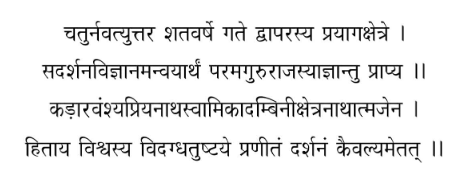
This Kaivalya Darsanam (exposition of Final Truth) has been written by Priya Nath Swami*, son of Kshetranath and Kadambini of the Karar family.
At the request in Allahabad of the Great Preceptor (Mahavatar Babaji) near the end of the 194th year of the present Dwapara Yuga, this exposition has been published for the benefit of the world.
* In 1894, when this book was written, Babaji gave the author the title of
Swami. He was later formally initiated into the Swami Order by the Mahant (monastery head) of Buddh Gaya, Bihar, and took the monastic name of Sri Yukteswar. He belonged to the Giri (mountain) branch of the Swami Order. (Publisher's Note)
The purpose of this book is to show as clearly as possible that there is an essential unity in all religions; that there is no difference in the truths inculcated by the various faiths; that there is but one method by which the world, both external and internal, has evolved; and that there is but one Goal admitted by all scriptures. But this basic truth is one not easily comprehended. The discord existing between the different religions, and the ignorance of men, make it almost impossible to lift the veil and have a look at this grand verity. The creeds foster a spirit of hostility and dissension; ignorance widens the gulf that separates one creed from another. Only a few specially gifted persons can rise superior to the influence of their professed creeds and find absolute unanimity in the truths propagated by all great faiths.
The object of this book is to point out the harmony underlying the various religions, and to help in binding them together. This task is indeed a herculean one, but at Allahabad I was entrusted with the mission by a holy command. Allahabad, the sacred Prayaga Tirtha, the place of confluence of the Ganges, Yamuna, and Saraswati rivers, is a site for the congregation of worldly men and of spiritual devotees at the time of Kumbha Mela. Worldly men cannot transcend the mundane limit in which they have confined themselves; nor can spiritual devotees, having once renounced the world, deign to come down and mix themselves in its turmoil. Yet men who are wholly engrossed in earthly concerns stand in definite need of help and guidance from those holy beings who bring light to the race. So a place there must be where union between the two sets is possible. Tirtha affords such a meeting place. Situated as it is on the beach of the world, storms and buffets touch it not; the sadhus (ascetics) with a message for the benefit of humanity find a Kumbha Mela to be an ideal place to impart instruction to those who can heed it.
A message of such a nature was I chosen to propagate when I paid a visit to the Kumbha Mela being held at Allahabad in January 1894. As I was walking along the bank of the Ganges, I was summoned by a man and was afterwards honored by an interview with a great holy person, Babaji, the gurudeva of my own guru, Lahiri Mahasaya, of Banaras. This holy personage at the Kumbha Mela was thus my own paramguruji maharaj*, though this was our first meeting.
* Paramguru, literally, guru beyond
, hence the guru of one's guru. The suffix ji denotes
respect. Maharaj, great king
, is a title often added to the names of exceptional spiritual
personages. (Publisher's Note)
During my conversation with Babaji, we spoke of the particular class of men who now frequent these places of pilgrimage. I humbly suggested that there were men greater by far in intelligence than most of those then present, men living in distant parts of the world—Europe and America—professing different creeds, and ignorant of the real significance of the Kumbha Mela. They were men fit to hold communion with the spiritual devotees, so far as intelligence is concerned; yet such intellectual men in foreign lands were, alas, wedded in many cases to rank materialism. Some of them, though famous for their investigations in the realms of science and philosophy, do not recognize the essential unity in religion. The professed creeds serve as nearly insurmountable barriers that threaten to separate mankind forever.
My paramguruji maharaj Babaji smiled and, honoring me with the title of Swami, imposed on me the task of this book. I was chosen, I do not know the reason why, to remove the barriers and to help in establishing the basic truth in all religions.
The book is divided into four sections, according to the four stages in the development of knowledge. The highest aim of religion is Atmajnanam, Self–knowledge. But to attain this, knowledge of the external world is necessary. Therefore the first section of the book deals with वेद (veda) the gospel, and seeks to establish fundamental truths of creation and to describe the evolution and involution of the world.
All creatures, from the highest to the lowest in the link of creation, are found eager to realize three things: Existence, Consciousness, and Bliss. These purposes or goals are the subject for discussion in the second section of the book. The third section deals with the method of realizing the three purposes of life. The fourth section discusses the revelations which come to those who have traveled far to realize the three ideals of life and who are very near their destination.
The method 1 have adopted in the book is first to enunciate a proposition in Sanskrit terms of the Oriental sages, and then to explain it by reference to the holy scriptures of the West. In this way I have tried my best to show that there is no real discrepancy, much less any real conflict, between the teachings of the East and the West. Written as the book is, under the inspiration of my paramgurudeva, and in a Dwapara Age of rapid development in all departments of knowledge, I hope that the significance of the book will not be missed by those for whom it is meant.
A short discussion with mathematical calculation of the yugas or ages will explain the fact that the present age for the world is Dwapara Yuga, and that 194 years of the Yuga have now (A.D. 1894) passed away, bringing a rapid development in man's knowledge.
We learn from Oriental astronomy that moons revolve around their planets, and planets turning on their axes revolve with their moons round the sun; and the sun, with its planets and their moons, takes some star for its dual and revolves round it in about 24,000 years of our earth—a celestial phenomenon which causes the backward movement of the equinoctial points around the zodiac. The sun also has another motion by which it revolves round a grand center called Vishnunabhi, which is the seat of the creative power, Brahma, the universal magnetism. Brahma regulates dharma, the mental virtue of the internal world.
When the sun in its revolution round its dual comes to the place nearest to this grand center, the seat of Brahma (an event which takes place when the Autumnal Equinox comes to the first point of Aries), dharma, the mental virtue, becomes so much developed that man can easily comprehend all, even the mysteries of Spirit.
The Autumnal Equinox will be falling, at the beginning of the twentieth century, among the fixed stars of the Virgo constellation, and in the early part of the Ascending Dwapara Yuga (see diagram below).
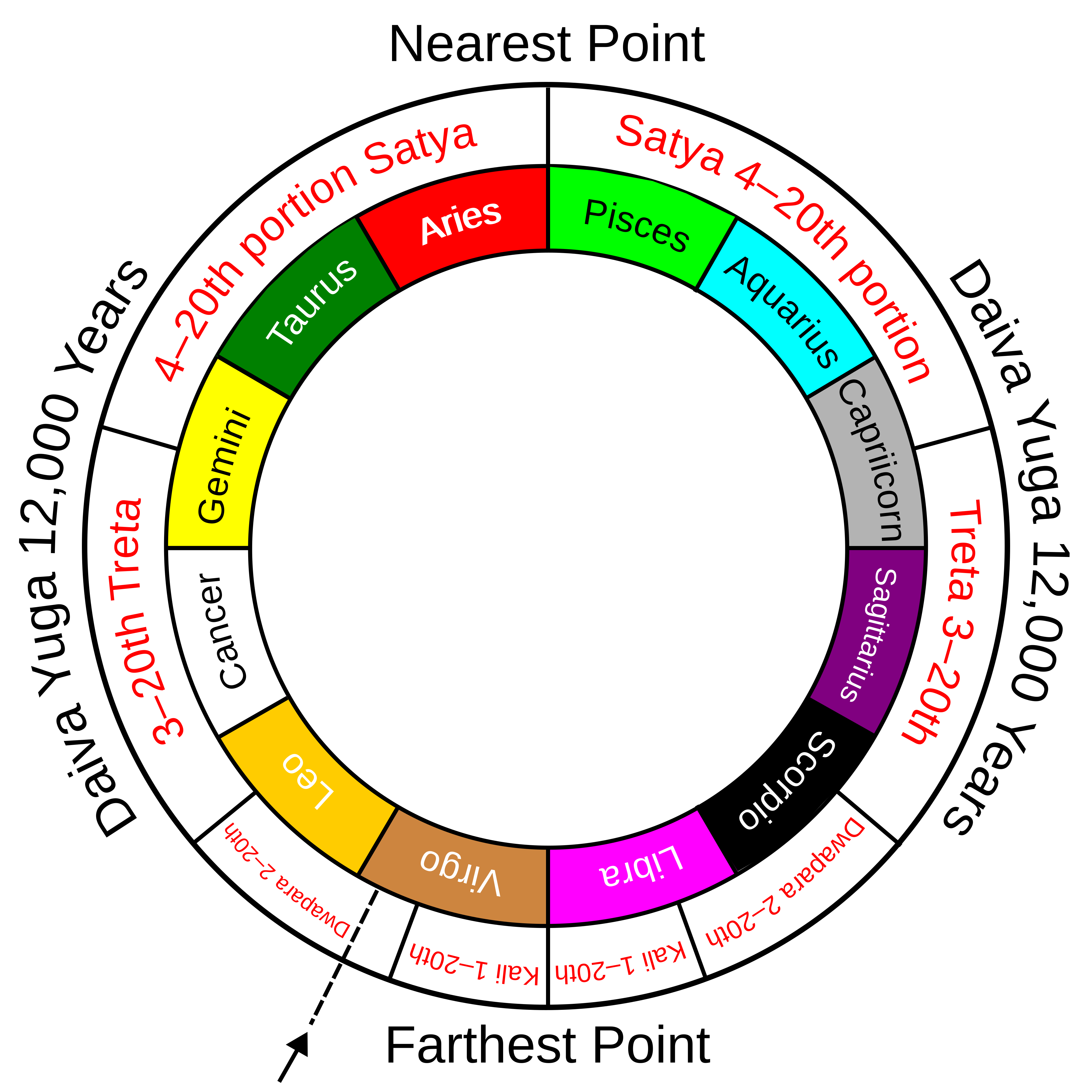
Piscean Age.
The Equinoxes have a retrograde movement in the constellations; hence, when the Equinoxes leave
Pisces–Virgo, they will enter Aquarius–Leo. According to Swami Sri Yukteswarji's theory, the world entered
the Pisces–Virgo Age in A.D. 499, and will enter the Aquarius–Leo Age two thousand years later, in A.D. 2499.
(Publisher;s Note)
— The original diagram was in black and white. We added colour to help make it easier to read.
After 12,000 years, when the sun goes to the place in its orbit which is farthest from Brahma, the grand center (an event which takes place when the Autumnal Equinox is on the first point of Libra), dharma, the mental virtue, comes to such a reduced state that man cannot grasp anything beyond the gross material creation. Again, in the same manner, when the sun in its course of revolution begins to advance toward the place nearest to the grand center, dharma, the mental virtue, begins to develop; this growth is gradually completed in another 12,000 years.
Each of these periods of 12,000 years brings a complete change, both externally in the material world, and internally in the intellectual or electric world, and is called one of the Daiva Yugas or Electric Couple. Thus, in a period of 24,000 years, the sun completes the revolution around its dual and finishes one electric cycle consisting of 12,000 years in an ascending arc and 12,000 years in a descending arc.
Development of dharma, the mental virtue, is but gradual and is divided into four different stages in a period of 12,000 years. The time of 1200 years during which the sun passes through a 1/20th portion of its orbit (see Diagram above) is called Kali Yuga. Dharma, the mental virtue, is then in its first stage and is only a quarter developed; the human intellect cannot comprehend anything beyond the gross material of this ever–changing creation, the external world.
The period of 2400 years during which the sun passes through the 2/20th portion of its orbit is called Dwapara Yuga. Dharma, the mental virtue, is then in the second stage of development and is but half complete; the human intellect can then comprehend the fine matters or electricities and their attributes which are the creating principles of the external world.
The period of 3600 years during which the sun passes through the 3/20th part of its orbit is called Treta Yuga. Dharma, the mental virtue, is then in the third stage; the human intellect becomes able to comprehend the divine magnetism, the source of all electrical forces on which the creation depends for its existence.
The period of 4800 years during which the sun passes through the remaining 4/20th portion of its orbit is called Satya Yuga. Dharma, the mental virtue, is then in its fourth stage and completes its full development; the human intellect can comprehend all, even God the Spirit beyond this visible world.
Manu, a great rishi (illumined sage) of Satya Yuga, describes these Yugas more clearly in the following passage from his Samhita:
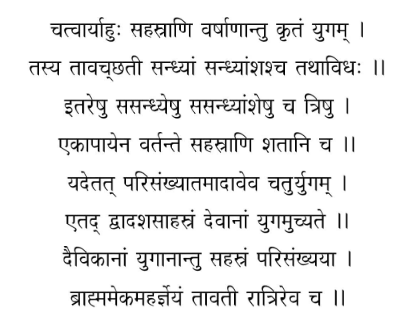
Four thousands of years, they say, is the Krita Yuga (Satya Yuga or the
Golden Ageof the world). Its morning twilight has just as many hundreds, and its period of evening dusk is of the same length (i.e., 400+4000+400=4800). In the other three ages, with their morning and evening twilights, the thousands and the hundreds decrease by one (i.e., 300+3000+ 300=3600; etc.). That fourfold cycle comprising 12,000 years is called an Age of the Gods. The sum of a thousand divine ages constitutes one day of Brahma; and of the same length is its night.
The period of Satya Yuga is 4000 years in duration; 400 years before and after Satya Yuga proper are its sandhis or periods of mutation with the preceding and the succeeding Yugas respectively; hence 4800 years in all is the proper age of Satya Yuga. In the calculation of the period of other Yugas and Yugasandhis, it is laid down that the numeral one should be deducted from the numbers of both thousands and hundreds which indicate the periods of the previous Yugas and sandhis. From this rule it appears that 3000 years is the length of Treta Yuga, and 300 years before and after are its sandhis, the periods of mutation, which make a total of 3600 years.
So 2000 years is the age of Dwapara Yuga, with 200 years before and after as its sandhis; a total of 2400 years. Lastly, 1000 years is the length of Kali Yuga, with 100 years before and after as its sandhis; a total of 1200 years. Thus 12,000 years, the sum total of all periods of these four Yugas, is the length of one of the Daiva Yugas or Electric Couple, two of which, that is, 24,000 years, make the electric cycle complete.
From 11,501 B.C., when the Autumnal Equinox was on the first point of Aries, the sun began to move away from the point of its orbit nearest to the grand center toward the point farthest from it, and accordingly the intellectual power of man began to diminish. During the 4800 years which the sun took to pass through one of the Satya Couples or 4/20th part of its orbit, the intellect of man lost altogether the power of grasping spiritual knowledge. During the 3600 years following, which the sun took to pass through the Descending Treta Yuga, the intellect gradually lost all power of grasping the knowledge of divine magnetism. During the 2400 years next following, while the sun passed through the Descending Dwapara Yuga, the human intellect lost its power of grasping the knowledge of electricities and their attributes. In 1200 more years the sun passed through the Descending Kali Yuga and reached the point in its orbit which is farthest from the grand center; the Autumnal Equinox was on the first point of Libra. The intellectual power of man was so much diminished that it could no longer comprehend anything beyond the gross material of creation. The period around A.D. 500 was thus the darkest part of Kali Yuga and of the whole cycle of 24,000 years. History indeed bears out the accuracy of these ancient calculations of the Indian rishis, and records the widespread ignorance and suffering in all nations at that period.
From A.D. 499 onward, the sun began to advance toward the grand center, and the intellect of man started gradually to develop. During the 1100 years of the Ascending Kali Yuga, which brings us to A.D. 1599, the human intellect was so dense that it could not comprehend the electricities, Sukshmabhuta, the fine matters of creation. In the political world also, generally speaking, there was no peace in any kingdom.
Subsequent to this period, when the 100–year transitional sandhi of Kali Yuga set in, to effect a union with the following Dwapara Yuga, men began to notice the existence of fine matters, panchatanmatra or the attributes of electricities; and political peace began to be established.
About A.D. 1600, William Gilbert discovered magnetic forces and observed the presence of electricity in all material substances. In 1609 Kepler discovered important laws of astronomy, and Galileo produced a telescope. In 1621 Drebbel of Holland invented the microscope. About 1670 Newton discovered the law of gravitation. In 1700 Thomas Savery made use of a steam engine in raising water. Twenty years later Stephen Gray discovered the action of electricity on the human body.
In the political world, people began to have respect for themselves, and civilization advanced in many ways. England united with Scotland and became a powerful kingdom. Napoleon Bonaparte introduced his new legal code into southern Europe. America won its independence, and many parts of Europe were peaceful.
With the advance of science, the world began to be covered with railways and telegraphic wires. By the help of steam engines, electric machines, and many other instruments, fine matters were brought into practical use, although their nature was not clearly understood. In 1899, on completion of the period of 200 years of Dwapara Sandhi, the time of mutation, the true Dwapara Yuga of 2000 years will commence and will give to mankind in general a thorough understanding of the electricities and their attributes.
Such is the great influence of Time which governs the universe. No man can overcome this influence except him who, blessed with pure love, the heavenly gift of nature, becomes divine; being baptized in the sacred stream Pranava (the holy Aum vibration), he comprehends the Kingdom of God.
The position of the world in the Dwapara Sandhi era at present (A.D. 1894) is not correctly shown in the Hindu almanacs. The astronomers and astrologers who calculate the almanacs have been guided by wrong annotations of certain Sanskrit scholars (such as Kulluka Bhatta) of the dark age of Kali Yuga, and now maintain that the length of Kali Yuga is 432,000 years, of which 4994 have (in A.D. 1894) passed away, leaving 427,006 years still remaining. A dark prospect! and fortunately one not true.
The mistake crept into almanacs for the first time during the reign of Raja Parikshit, just after the completion of the last Descending Dwapara Yuga. At that time Maharaja Yudhisthira, noticing the appearance of the dark Kali Yuga, made over his throne to his grandson, the said Raja Parikshit. Maharaja Yudhisthira, together with all the wise men of his court, retired to the Himalaya Mountains, the paradise of the world. Thus there was none in the court of Raja Parikshit who could understand the principle of correctly calculating the ages of the several Yugas.
Hence, after the completion of the 2400 years of the then current Dwapara Yuga, no one dared to make the introduction of the dark Kali Yuga more manifest by beginning to calculate from its first year and to put an end to the number of Dwapara years.
According to this wrong method of calculation, therefore, the first year of Kali Yuga was numbered 2401 along with the age of Dwapara Yuga. In A.D. 499, when 1200 years, the length of the true Kali Yuga, was complete, and the sun had reached the point of its orbit farthest from the grand center (when the Autumnal Equinox was on the first point ofLibra in the heavens), the age of Kali in its darkest period was then numbered by 3600 years instead of by 1200.
With the commencement of the Ascending Kali Yuga, after A.D. 499, the sun began to advance in its orbit nearer to the grand center, and accordingly the intellectual power of man started to develop. Therefore the mistake in the almanacs began to be noticed by the wise men of the time, who found that the calculations of the ancient rishis had fixed the period of one Kali Yuga at 1200 years only. But as the intellect of these wise men was not yet suitably developed, they could make out only the mistake itself, and not the reason for it. By way of reconciliation, they fancied that 1200 years, the
real age of Kali, were not the ordinary years of our earth, but were so many daiva years (years of the gods
), consisting of 12 datva months of 30 daiva days each, with each daiva day being equal to one
ordinary solar year of our earth. Hence according to these men 1200 years of Kali Yuga must be equal to 432,000 years of our earth.
In coming to a right conclusion, however, we should take into consideration the position of the Vernal Equinox at spring in the year 1894.
The astronomical reference books show the Vernal Equinox now to be 20°54'36" distant from the first point of Aries (the fixed star Revati), and by calculation it will appear that 1394 years have passed since the time when the Vernal Equinox began to recede from the first point of Aries.
Deducting 1200 years (the length of the last Ascending Kali Yuga) from 1394 years, we get 194 to indicate the present year of the world's entrance into the Ascending Dwapara Yuga. The mistake of older almanacs will thus be clearly explained when we add 3600 years to this period of 1394 years and get 4994 years—which according to the prevailing mistaken theory represents the present year (A.D. 1894) in the Hindu almanacs.
Referring to the Diagram given in this book (seen above), the reader will see that the Autumnal Equinox is now (A.D. 1894) falling among the stars of the Virgo constellation, and in the Ascending Dwapara Yuga.
In this book certain truths such as those about the properties of magnetism, its auras, different sorts of electricities, etc., have been mentioned, although modern science has not yet fully discovered them. The five sorts of electricity can be easily understood if one will direct his attention to the nerve properties, which are purely electrical in nature. Each of the five sensory nerves has its characteristic and unique function to perform. The optic nerve carries light and does not perform the functions of the auditory and other nerves; the auditory nerve in its turn carries sound only, without performing the functions of any other nerves, and so on. Thus it is clear that there are five sorts of electricity, corresponding to the five properties of cosmic electricity.
So far as magnetic properties are concerned, the grasping power of the human intellect is at present so limited that it would be quite useless to attempt to make the matter understood by the general public. The intellect of man in Treta Yuga will comprehend the attributes of divine magnetism (the next Treta Yuga will start in A.D. 4099). There are indeed exceptional personages now living who, having overcome the influence of Time, can grasp today what ordinary people cannot grasp; but this book is not for those exalted ones, who require nothing of it.
In concluding this introduction, we may observe that the different planets, exercising their influence over the various days of the week, have lent their names to their respective days; similarly, the different constellations of stars, having influence over various months, have lent their names to the Hindu months. Each of the great Yugas has much influence over the period of time covered by it; hence, in designating the years it is desirable that such terms should indicate to which Yuga they belong.
As the Yugas are calculated from the position of the equinox, the method of numbering the years in reference to their respective Yuga is based on a scientific principle; its use will obviate much inconvenience which has arisen in the past owing to association of the various eras with persons of eminence rather than with celestial phenomena of the fixed stars. We therefore propose to name and number the year in which this introduction has been written as 194 Dwapara instead of A.D. 1894, to show the exact time to the Yuga now passing. This method of calculation was prevalent in India till the reign of Raja Vikramaditya, when the Samvat era was introduced. As the Yuga method of calculation recommends itself to reason, we follow it, and recommend that it be followed by the public in general.
The Samvat era or Vikram Samvat (also known as Vikrami or or Bikrami calendar), is a lunisolar calendar. It is used traditionally in both Hinduism and Sikhism. The Vikram Samvat started 57 years before the Gregorian calendar. It is used primarily in India and Nepal.
In India it used primarily for religious dates, etc. In Nepal, it is an official calendar and is used for everything from schools to legal contracts.
You can find the Vikram Samvat calendar online.
This linisolar calendar features 12 months and the Nepali New Year, or
Nava Varsha, falls on the first day of Baisakh, usually around April 13 or 14.— The information about the Vikram Samvat did not appear in the original book. We added this information for purely informational purposes.
Now, in this 194th year of Dwapara Yuga, the dark age of Kali having long since passed, the world is reaching out for spiritual knowledge, and men require loving help one from the other. The publishing of this book, requested from me by my holy paramguru maharaj Babaji, will, I hope, be of spiritual service.
— Swami Sri Yukteswar Giri
Serampore, West Bengal
The 26th Falgun, 194 Dwapara
(A.D. 1894)

Chapters
| Holy Science: ForewordProphets nirbikalpa samadhi revelations Jnanavatar Babaji Lahiri Mahasaya Bhagavad Gita samkhya sankhya foreword |
| Holy Science: Prefacepreface tibetan yoga |
| Holy Science: Introductionintroduction giri yuga diagram Babaji mountain Prayaga Tirtha Ganges Yamuna Saraswati Kumbha Mela Tirtha Vishnunabhi sadhus Atmajnanam self knowledge veda gospel yuga Dwapara Yuga Brahma dharma Autumnal Equinox Aries Virgo pisces Vernal Equinox Piscean Age Aquarius leo Libra Daiva Yugas Electric Couple Kali Yuga Treta Yuga Satya Yuga Manu rishi Krita Yuga sandhis Yugasandhis Sukshmabhuta panchatanmatra electricity Sir Isaac Newton Gilbert Kepler Pranava aum Kulluka Bhatta Raja Parikshit Maharaja Yudhisthira Himalaya datva daiva Revati magnetism auras five sensory nerves Raja Vikramaditya Samvat |
| Holy Science: Chapter 1 The Gospelsutras god Swami Parambrahma Maya satchitananda Prakriti Shakti Vasana Bhoga Omniscient Consciousness Chetana Bhokta Genesis Omnipotent kala desa anu Atom Word Time Space patra Revelation john Amen god Kutastha Chaitanya holy ghost Purushottama Premabijam Chit Abhasa Chaitanya Purusha Buddhi Ahamkara Manas Chitta Kshiti Tejas Marut Vyoma Akasha Sthulasarira Swargas Satyaloka Anama Tapoloka Maharloka Alakshya Dasamadwara Mahasunya Bhuvarloka Bhuloka sapta Patalas Bhuvanas koshas Bhakti Sushumnadwara Parokshajnana Radha Trikuti Kaivalya Christ Consciousness Abhasa Chaitanya Sannyasi |
| Holy Science: Chapter 2 The Goalsutras maya evil Purusha jiva liberation soul Avidya ignorance Abhinivesa tenacity Asmita ego Raga attachment Dwesha aversion Artha suffering Paramartha the ultimate goal Existence consciousness and bliss sat chitananda satguru sat-guru |
| Holy Science: Chapter 3 The Proceduresutras maya Yajna sacrifice penance Tapas deep study Swadhyaya meditation aum Brahmanidhana Swadhyaya Pranava Brahman spirit salvation sravana manana Virya Sraddha Samadhi Smriti love concentration Pranava Sabda satchitananda sat-guru moral courage true conception Yama morality Niyama religious rules Niyama sexual desire natural living teeth organs food chikdren disease diet omnivore carnivoe herbivore fruitarian Asat Asana pranayama Pratyahara withdrawal of senses Viratwam Mahattwam Garhasthyasrama nerves Samyama john the baptist Bhuvarloka Devata Avidya sudra Kshatriya Radha Sushumnadwara Lokas Swargas Janaloka Tapoloka Satyaloka Dasamadwara Dwapara Yuga Dvija Vipra Chitta Treta Yuga Maharloka Brahmana Kaivalya |
| Holy Science: Chapter 4 The Revelationsutras maya mantras Pranava aum Chitta sadhana Pravartaka sat-guru Pravritti Pravartaka Yama Niyama Sadhaka Siddha Sabda Patala Lokas rishis Bhakti Yoga Surat Sabda Yoga Bhuloka Bhuvarloka ajna chakra sahasrara vishuddha anahata seven centres seven churches seven chakras swadhishthana manipura Surat Sabda Yoga Swarloka Swargas manus Maharloka Avidya manava Maharloka Brahmarandhra Dasamadwara aiswaryas Anima Mahima Laghima Garima Prapti Vasitwa Prakamya mahat laghu apti guru vasa kama Isa aiswaryas Kaivalya discipline |
| Holy Science: Conclusionconclusion lotus love |
| Holy Science: About The Authorabout rishi Serampore calculatta Jnanavatar death yogananda self realization fellowship discipline |
Send Message
The Real Yoga
website is designed to be a self–study website. But, feel free
to send us a message — but do make sure your email is correct.
Respecting Your Privacy
No spying. No cookies. No Google. No advertising. No tracking. No joking — well, maybe a few jokes.
Say yes to 100% free! Two thumbs up!










IndexPV Part 1PV Part 2PV Part 3PV Part 4HS ForewordHS PrefaceHS IntroductionHS Chapter 1HS Chapter 2HS Chapter 3HS Chapter 4HS ConclusionHS AboutPS IntroPS Book ⅠPS Book ⅠⅠPS Book ⅠⅠⅠPS Book IVI Am Brahman