












 IndexPV Part 1PV Part 2PV Part 3PV Part 4HS ForewordHS PrefaceHS IntroductionHS Chapter 1HS Chapter 2HS Chapter 3HS Chapter 4HS ConclusionHS AboutPS IntroPS Book ⅠPS Book ⅠⅠPS Book ⅠⅠⅠPS Book IV
Chapter 4 विभूति: The Revelation
The Holy Science
कैवल्यदर्शनम्
by Jnanavatar Swami Sri Yukteswar Giri (1894).
In this book, Swami Yukteswar helps us see the unity among different religions and that all truths are but one truth. This is a must read for all those interested in Yoga.
Due to its original publication date in 1894, which places it outside of the copyright period for most
works, The Holy Science
is in the public domain.
Sutra 1 — 3
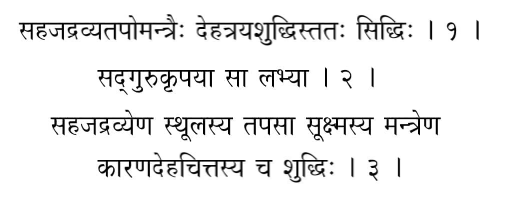
Adeptship is achieved by purification of man's three bodies. It is also attainable through the grace of the guru.
Purification comes through Nature, penance, and mantras.
Through Nature there is purification of dense matter (the physical body); through penance, purification of the fine matter (the subtle body); through mantras, purification of the mind.
Adeptship is attainable by the purification of the body in all respects. Purification of the material body can be effected by things generated along with it by Nature; that of the electric body by patience in all circumstances; and that of the magnetic body ( chitta, spiritualized Atom, Heart) by regulation of the breath, which is called mantra, the purifier of the mind (
 ). The process of how these purifications can be effected may be learnt at the feet of the divine personages who witness Light and bear testimony of the Christ Consciousness.
Sutra 4, 5

Through the holy effect of the mantra, the Pranava or Aum sound becomes audible.
The sacred sound is heard in various ways, according to the devotee's stage of advancement (in purifying his heart).
By culture of regulation of the breath as directed by the Spiritual Preceptor (Sat–Guru), the holy Word ( Pranava or Sabda) spontaneously appears and becomes audible. When this mantra (Word, Pranava) appears, the breath becomes regulated and checks the decay of the material body.
This Pranava appears in different forms at the different stages of advancement, according to the purification of the heart (Chitta).
Sutra 6
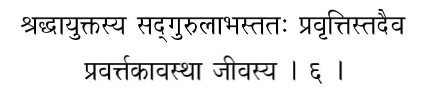
One who cultivates the heart's natural love obtains the guidance of a guru, and starts his sadhana (path of spiritual discipline). He becomes a Pravartaka, an initiate.
It has already been explained what Sat–Guru is and how to keep the company thereof. Man, when endowed with the heavenly gift of pure love, naturally becomes disposed to avoid the company of what is Asat and to keep the company of what has been described as Sat.
By affectionately keeping the company of Sat he may be fortunate enough to please one who may kindly stand to him as his Sat–Guru or Spiritual Preceptor. By keeping his preceptor's Godlike company there grows an inclination, Pravritti, in the disciple's heart to save himself from the creation of darkness, Maya, and he becomes Pravartaka, an initiate in the practices of Yama and Niyama, the ascetic forbearances and observances necessary to obtain salvation.
Sutra 7
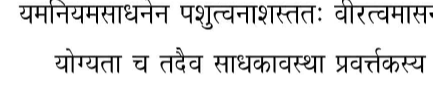
By the practice of Yama and Niyama, the eight meannesses of the human heart disappear and virtue arises. Man thus becomes a Sadhaka, a true disciple, fit to attain salvation.
It may be remembered that by the culture of Yama and Niyama, the eight meannesses vanish from the human heart and magnanimity comes in. It is at this stage that man becomes fit for the practice of ascetic posture and the other processes pointed out by his Sat–Guru to attain salvation; when he continues to practice the processes so pointed out to him by his Sat–Guru he becomes a Sadhaka or disciple.
Sutra 8
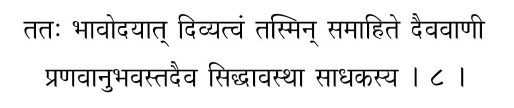
He progresses in godliness, hears the holy Aum sound, and becomes a Siddha, divine personage.
On reference to Chapter 3 it will be found how a disciple, while passing through the different stages, becomes able to conceive the different objects of creation in his heart; and how he gradually advances through the states of meditation; and how, ultimately, by concentrating his attention on the sensorium, he perceives the peculiar sound, Pranava or Sabda, the holy Word, at which time the heart becomes divine and the Ego, Ahamkara, or son of man becomes merged or baptized in the stream thereof, and the disciple becomes Siddha, an adept, a divine personage.
Sutra 9

Then he perceives the manifestations of Spirit, and passes through the seven Patala Lokas (or centres in the spine), beholding the seven rishis.
In the state of baptism (Bhakti Yoga, or Surat Sabda Yoga, absorption of the Ego in the holy Sound) man repents and withdraws his self from the external world of gross matters, Bhuloka, and enters into the internal one of fine matter, the Bhuvarloka. There he perceives the manifestation of Spirit, the true Light, like seven stars in seven centres or astrally shining places, which are compared to seven golden candlesticks. These stars, being the manifestation of true Light, the Spirit, are called angels or rishis, which appear one after another in the right hand of the son of man; that is, in his right way to Divinity.
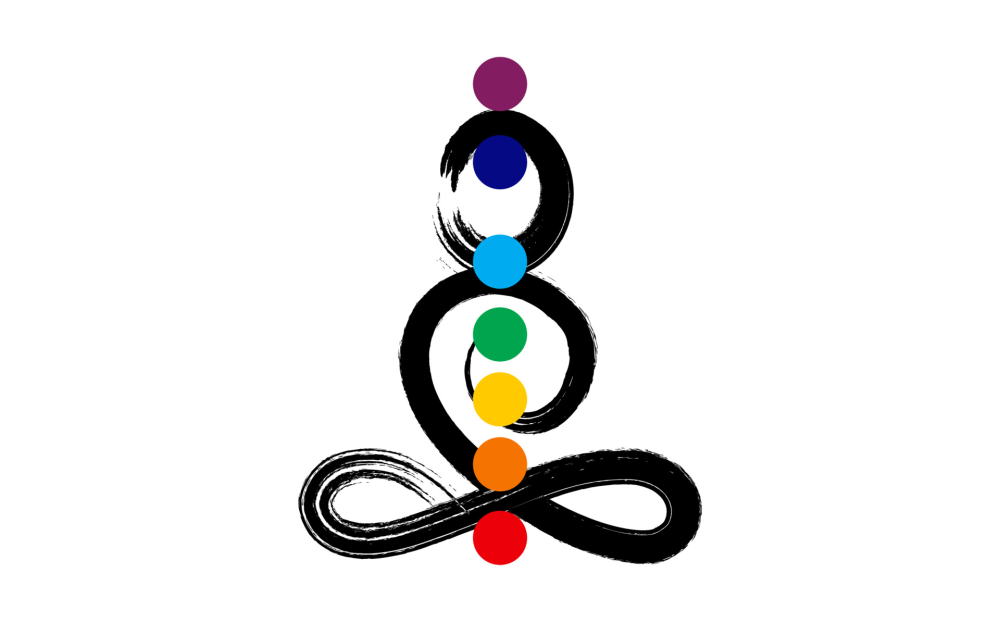
The seven golden candlesticks are the seven shining places in the body, known as brain, the sahasrara; medulla oblongata, the ajna chakra; and five spinal centers—cervical, vishuddha; dorsal, anahata; lumbar, manipura; sacral, swadhishthana; and coccygeal, muladhara, where the Spirit becomes manifested. Through these seven centres or churches, the Ego or son of man passes toward the Divinity. See Revelation 1:12, 13, 16, 20, and 2:1.
And being turned, I saw seven golden candlesticks; and in the midst of the seven candlesticks one like unto the son of man.… And he had in his right hand seven stars.
The mystery of the seven stars which thou sawest in my right hand, and the seven golden candlesticks. The seven stars are the angels of the seven churches; and the seven candlesticks which thou sawest are the seven churches.
These things saith he that holdeth the seven stars in his right hand, who walketh in the midst of the seven golden candlesticks.
In this state of baptism (Bhakti Yoga or Surat Sabda Yoga) the Ego, Surat, the son of man, gradually passing through the seven places mentioned, acquires the knowledge thereof; and when he thus completes the journey through the whole of these regions he understands the true nature of the universe. Withdrawing his self from Bhuvarloka, the fine material creation, he enters into Swarloka, the source of all matters, fine and gross. There he perceives the luminous astral form around his Heart, Atom, the throne of Spirit the Creator, provided with five electricities and with two poles, Mind and Intelligence, of seven different colors as in rainbows. In this sphere of electricities, mind and intelligence, the source of all objects of senses and of organs for their enjoyment, man becomes perfectly satisfied with being in possession of all objects of his desires, and acquires a complete knowledge thereof. Hence the aforesaid astral form with its electricities and poles, the seven parts thereof, has been described as a sealed casket of knowledge, a book with seven seals. See Revelation 4:3 and 5:1.
And there was a rainbow round about the throne.
And I saw in the right hand of him that sat on the throne a book written within and on the back side, sealed with seven seals.
Sutra 10
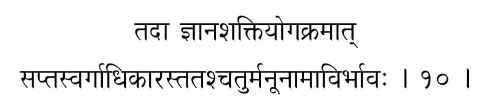
Then, because of yoga knowledge and power, man obtains supremacy over the seven Swargas
(heavens). He achieves salvation by dissolving the four original ideas (the four manus
or primal
thoughts by which creation sprang into being).
Passing through this Swarloka, the son of man comes to Maharloka, the place of magnet (the Atom), of which the ideas of manifestation (Word), Time, Space, and particle (Atom) are the four component parts. As mentioned in Chapter 1, this Maharloka represents Avidya, Ignorance, which produces the idea of separate existence of self and is the source of Ego, the son of man. Thus man ( , manava), being the offspring of Ignorance, and Ignorance being represented by the four ideas aforesaid, these ideas are called the four manus (
 ), the origins or sources of man.
Sutra 11

Being thus victorious over the powers of Darkness and Ignorance, man becomes one with God
Maharloka, the place of Magnet (Atom), is the Brahmarandhra or Dasamadwara, the door between two creations, material and spiritual. When Ego, the son of man, comes to the door, he comprehends the Spiritual Light and becomes baptized therein. And passing through this door he comes above the ideational creation of Darkness, Maya, and entering into the spiritual world, receives the true Light and becomes the Son of God. Thus man, being the Son of God, overcomes all bondage of Darkness, Maya, and becomes possessed of all aiswaryas, the ascetic majesties. These aiswaryas are of eight sorts:
Anima, the power of making one's body or anything else as small as he likes, even as tiny as an atom, anu.
Mahima, the power of magnifying or making one's body or anything else mahat, as large as he likes.
Laghima, the power of making one's body or anything else laghu, as light in weight as he likes.
Garima, the power of making one's body or anything else guru, as heavy as he likes.
Prapti, the power of apti, obtaining anything he likes.
Vasitwa, the power of vasa, bringing anything under control.
Prakamya, the power of satisfying all desires, kama, by irresistible will force.
Isitwa, the power of becoming Isa, Lord, over everything. See John 14:12.
Verily, verily, I say unto you, he that believeth on me, the works that I do shall he do also; and greater works than these shall he do; because I go unto my Father.
Sutra 12

Knowledge of evolution, life, and dissolution thus leads to complete emancipation from the bonds of Maya, delusion. Beholding the self in the Supreme Self, man gains eternal freedom.
Thus man, being possessed of aiswaryas, the ascetic majesties aforesaid, fully comprehends the Eternal Spirit, the Father, the only Real Substance, as Unit, the Perfect Whole, and his Self as nothing but a mere idea resting on a fragment of the Spiritual Light thereof. Man, thus comprehending, abandons altogether the vain idea of the separate existence of his own Self and becomes unified with Him, the Eternal Spirit, God the Father. This unification with God is Kaivalya, the ultimate goal of man, as explained in this treatise. See Revelation 3:21.
To him that overcometh will I grant to sit with me in my throne, even as I also overcame, and am set down with my Father in his throne.
Chapters
| Holy Science: ForewordProphets nirbikalpa samadhi revelations Jnanavatar Babaji Lahiri Mahasaya Bhagavad Gita samkhya sankhya foreword |
| Holy Science: Prefacepreface tibetan yoga |
| Holy Science: Introductionintroduction giri yuga diagram Babaji mountain Prayaga Tirtha Ganges Yamuna Saraswati Kumbha Mela Tirtha Vishnunabhi sadhus Atmajnanam self knowledge veda gospel yuga Dwapara Yuga Brahma dharma Autumnal Equinox Aries Virgo pisces Vernal Equinox Piscean Age Aquarius leo Libra Daiva Yugas Electric Couple Kali Yuga Treta Yuga Satya Yuga Manu rishi Krita Yuga sandhis Yugasandhis Sukshmabhuta panchatanmatra electricity Sir Isaac Newton Gilbert Kepler Pranava aum Kulluka Bhatta Raja Parikshit Maharaja Yudhisthira Himalaya datva daiva Revati magnetism auras five sensory nerves Raja Vikramaditya Samvat |
| Holy Science: Chapter 1 The Gospelsutras god Swami Parambrahma Maya satchitananda Prakriti Shakti Vasana Bhoga Omniscient Consciousness Chetana Bhokta Genesis Omnipotent kala desa anu Atom Word Time Space patra Revelation john Amen god Kutastha Chaitanya holy ghost Purushottama Premabijam Chit Abhasa Chaitanya Purusha Buddhi Ahamkara Manas Chitta Kshiti Tejas Marut Vyoma Akasha Sthulasarira Swargas Satyaloka Anama Tapoloka Maharloka Alakshya Dasamadwara Mahasunya Bhuvarloka Bhuloka sapta Patalas Bhuvanas koshas Bhakti Sushumnadwara Parokshajnana Radha Trikuti Kaivalya Christ Consciousness Abhasa Chaitanya Sannyasi |
| Holy Science: Chapter 2 The Goalsutras maya evil Purusha jiva liberation soul Avidya ignorance Abhinivesa tenacity Asmita ego Raga attachment Dwesha aversion Artha suffering Paramartha the ultimate goal Existence consciousness and bliss sat chitananda satguru sat-guru |
| Holy Science: Chapter 3 The Proceduresutras maya Yajna sacrifice penance Tapas deep study Swadhyaya meditation aum Brahmanidhana Swadhyaya Pranava Brahman spirit salvation sravana manana Virya Sraddha Samadhi Smriti love concentration Pranava Sabda satchitananda sat-guru moral courage true conception Yama morality Niyama religious rules Niyama sexual desire natural living teeth organs food chikdren disease diet omnivore carnivoe herbivore fruitarian Asat Asana pranayama Pratyahara withdrawal of senses Viratwam Mahattwam Garhasthyasrama nerves Samyama john the baptist Bhuvarloka Devata Avidya sudra Kshatriya Radha Sushumnadwara Lokas Swargas Janaloka Tapoloka Satyaloka Dasamadwara Dwapara Yuga Dvija Vipra Chitta Treta Yuga Maharloka Brahmana Kaivalya |
| Holy Science: Chapter 4 The Revelationsutras maya mantras Pranava aum Chitta sadhana Pravartaka sat-guru Pravritti Pravartaka Yama Niyama Sadhaka Siddha Sabda Patala Lokas rishis Bhakti Yoga Surat Sabda Yoga Bhuloka Bhuvarloka ajna chakra sahasrara vishuddha anahata seven centres seven churches seven chakras swadhishthana manipura Surat Sabda Yoga Swarloka Swargas manus Maharloka Avidya manava Maharloka Brahmarandhra Dasamadwara aiswaryas Anima Mahima Laghima Garima Prapti Vasitwa Prakamya mahat laghu apti guru vasa kama Isa aiswaryas Kaivalya discipline |
| Holy Science: Conclusionconclusion lotus love |
| Holy Science: About The Authorabout rishi Serampore calculatta Jnanavatar death yogananda self realization fellowship discipline |
Send Message
The Real Yoga
website is designed to be a self–study website. But, feel free
to send us a message — but do make sure your email is correct.
Respecting Your Privacy
No spying. No cookies. No Google. No advertising. No tracking. No joking — well, maybe a few jokes.
Say yes to 100% free! Two thumbs up!










IndexPV Part 1PV Part 2PV Part 3PV Part 4HS ForewordHS PrefaceHS IntroductionHS Chapter 1HS Chapter 2HS Chapter 3HS Chapter 4HS ConclusionHS AboutPS IntroPS Book ⅠPS Book ⅠⅠPS Book ⅠⅠⅠPS Book IVAwaken The Guru Within