












Chapter 2 अभीष्टम् । The Goal
The Holy Science
कैवल्यदर्शनम्
by Jnanavatar Swami Sri Yukteswar Giri (1894).
In this book, Swami Yukteswar helps us see the unity among different religions and that all truths are but one truth. This is a must read for all those interested in Yoga.
Due to its original publication date in 1894, which places it outside of the copyright period for most
works, The Holy Science
is in the public domain.
Sutra 1

Hence there is desire for emancipation.
Liberation, the prime object. When man understands even by way of inference the true nature of this creation, the true relation existing between this creation and himself; and when he further understands that he is completely blinded by the influence of Darkness, Maya, and that it is the bondage of Darkness alone which makes him forget his real Self and brings about all his sufferings, he naturally wishes to be relieved from all these evils. This relief from evil, or liberation from the bondage of Maya, becomes the prime object of his life.
Sutra 2

Liberation is stabilization of Purusha (jiva, soul) in its real Self.
Residing in Self is liberation. When man raises himself above the idea creation of this Darkness, Maya, and passes completely out of its influence, he becomes liberated from bondage and is placed in his real Self, the Eternal Spirit.
Sutra 3

Then there is cessation of all pain and the attainment of the ultimate aim (true fulfillment, God–realization)
Liberation is salvation. On attaining this liberation, man becomes saved from all his troubles, and all the desires of his heart are fulfilled, so the ultimate aim of his life is accomplished.
Sutra 4

Otherwise, birth after birth, man experiences the misery of unfulfilled desires.
Why man suffers. So long, however, as man identifies himself with his material body and fails to find repose in his true Self, he feels his wants according as his heart's desires remain unsatisfied. To satisfy them he has to appear often in flesh and blood on the stage of life, subject to the influence of Darkness, Maya, and has to suffer all the troubles of life and death not only in the present but in the future as well.
Sutra 5, 6
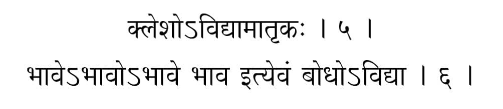
Troubles are born from Avidya, Ignorance. Ignorance is the perception of the nonexistent, and the nonperception of the Existent.
What is ignorance? Ignorance, Avidya, is misconception, or is the erroneous conception of the existence of that which does not exist. Through Avidya man believes that this material creation is the only thing that substantially exists, there being nothing beyond, forgetting that this material creation is substantially nothing and is a mere play of ideas on the Eternal Spirit, the only Real Substance, beyond the comprehension of the material creation. This Ignorance is not only a trouble in itself but is also the source of all the other troubles of man.
Sutra 7 — 12
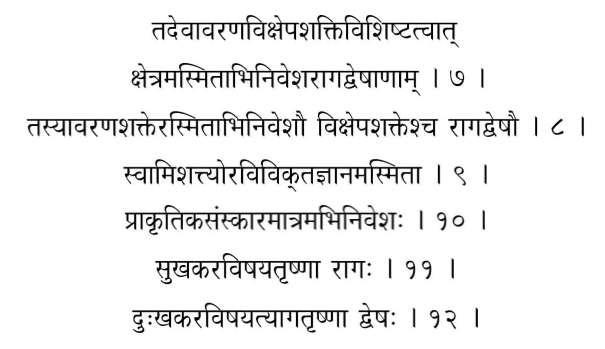
Avidya, Ignorance, having the twofold power of polarity, manifests as egoism, attachment, aversion, and (blind) tenacity.
The darkening power of Maya produces egoism and (blind) tenacity; the polarity power of Maya produces attachment (attraction) and aversion (repulsion).
Egoism results from a lack of discrimination between the physical body and the real Self.
Tenacity is a result of natural conditioning (belief in Nature and her laws as final, instead of belief in the all–causative powers of the Soul).
Attachment means thirst for the objects of happiness.
Aversion means desire for the removal of the objects of unhappiness.
Ignorance is the source of all troubles. In order to understand how this Ignorance is the source of all other troubles we should remember (as has been explained in the previous chapter) that Ignorance, Avidya, is nothing but a particle of Darkness, Maya, taken distributively, and as such it possesses the two properties of Maya. The one is its darkening power, by the influence of which man is prevented from grasping anything beyond the material creation. This darkening power produces Asmita or Egoism, the identification of Self with the material body, which is but the development of Atom, the particles of the universal force; and Abhinivesa or blind tenacity to the belief in the validity and ultimate worth of the material creation.
By virtue of the second of the properties of Maya, Ignorance or Avidya in its polarized state produces attraction for certain objects and repulsion for others. The objects so attracted are the objects of pleasure, for which an Attachment, Raga, is formed. The objects that are repulsed are the objects producing pain, for which an Aversion, Dwesha, is formed.
Sutra 13

The root of pain is egoistic actions, which (being based on delusions) lead to misery.
Why man is bound. By the influence of these five troubles—Ignorance, Egoism, Attachment, Aversion, and Tenacity to the material creation—man is induced to involve himself in egoistic works and in consequence he suffers.
Sutra 14 — 15
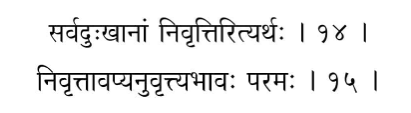
Man’s purpose is complete freedom from unhappiness.
Once he has banished all pain beyond possibility of return, he has attained the highest goal
Ultimate aim of the heart. With man the cessation of all suffering is Artha, the heart’s immediate aim. The complete extirpation of all these sufferings so that their recurrence becomes impossible, is Paramartha, the ultimate goal.
Sutra 16 — 21
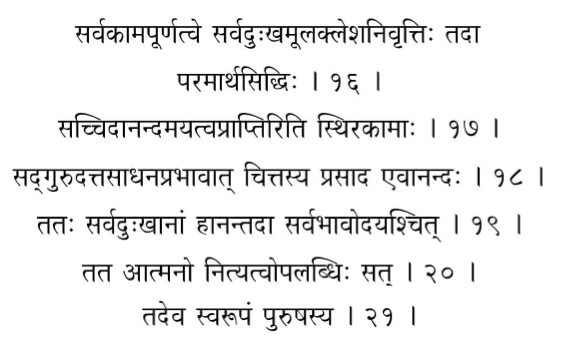
Existence, consciousness, and bliss are the three longings (of the human heart).
Ananda, bliss, is the contentment of heart attained by the ways and means suggested by the Saviour, the Sat–Guru.
Chit, true consciousness, brings about the complete destruction of all troubles and the rise of all virtues.
Sat, existence, is attained by realization of the permanency of the soul.
These three qualities constitute the real nature of man. All desires being fulfilled, and all miseries removed, the achievement of Paramartha (the highest goal) is made.
The real necessities. Man naturally feels great necessity for Sat, Existence; Chit, Consciousness; and Ananda, Bliss. These three are the real necessities of the human heart and have nothing to do with anything outside his Self. They are essential properties of his own nature, as explained in the previous chapter.
How man attains Bliss. When man becomes fortunate in securing the favor of any divine personage, Sat–Guru (the Savior), and affectionately following his holy precepts is able to direct all his attention inward, he becomes capable of satisfying all the wants of his heart and can thereby gain contentment, Ananda, the Real Bliss.
How Consciousness appears. With his heart thus contented, man becomes able to fix his attention upon anything he chooses and can comprehend all its aspects. So Chit, Consciousness of all the modifications of Nature up to its first and primal manifestation, the Word (Amen, Aum), and even of his own Real Self, gradually appears. And being absorbed in the stream thereof, man becomes baptized and begins to repent and return toward his Divinity, the Eternal Father, whence he had fallen. See Revelation 2:5.
Remember therefore from whence thou art fallen, and repent.
How Existence is realized. Man, being conscious of his own real position and of the nature of this creation of Darkness, Maya, becomes possessed of absolute power over it, and gradually withdraws all the developments of Ignorance. In this way, freed from the control of this creation of Darkness, he comprehends his own Self as Indestructible and Ever–Existing Real Substance. So Sat, the Existence of Self, comes to light.
How main object of the heart is attained. All the necessities of the heart—Sat, Existence; Chit, Consciousness; and Ananda, Bliss—having been attained, Ignorance, the mother of evils, becomes emaciated and consequently all troubles of this material world, which are the sources of all sorts of sufferings, cease forever. Thus the ultimate aim of the heart is effected.
Sutra 22
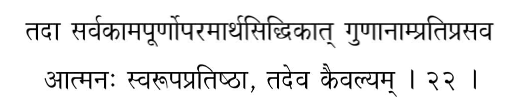
All fulfilments of his nature attained, man is not merely a reflector of divine light but becomes actively united with Spirit. This state is Kaivalya, oneness.
How man finds salvation. In this state, all the necessities having been attained and the ultimate aim effected, the heart becomes perfectly purified and, instead of merely reflecting the spiritual light, actively manifests the same. Man, being thus consecrated or anointed by the Holy Spirit, becomes Christ, the anointed Saviour. Entering the kingdom of Spiritual Light, he becomes the Son of God.
In this state man comprehends his Self as a fragment of the Universal Holy Spirit, and, abandoning the vain idea of his separate existence, unifies himself with the Eternal Spirit; that is, becomes one and the same with God the Father. This unification of Self with God is Kaivalya, which is the Ultimate Object of all created beings. See John 14:11.
Believe me that I am in the Father, and the Father in me.

Chapters
| Holy Science: ForewordProphets nirbikalpa samadhi revelations Jnanavatar Babaji Lahiri Mahasaya Bhagavad Gita samkhya sankhya foreword |
| Holy Science: Prefacepreface tibetan yoga |
| Holy Science: Introductionintroduction giri yuga diagram Babaji mountain Prayaga Tirtha Ganges Yamuna Saraswati Kumbha Mela Tirtha Vishnunabhi sadhus Atmajnanam self knowledge veda gospel yuga Dwapara Yuga Brahma dharma Autumnal Equinox Aries Virgo pisces Vernal Equinox Piscean Age Aquarius leo Libra Daiva Yugas Electric Couple Kali Yuga Treta Yuga Satya Yuga Manu rishi Krita Yuga sandhis Yugasandhis Sukshmabhuta panchatanmatra electricity Sir Isaac Newton Gilbert Kepler Pranava aum Kulluka Bhatta Raja Parikshit Maharaja Yudhisthira Himalaya datva daiva Revati magnetism auras five sensory nerves Raja Vikramaditya Samvat |
| Holy Science: Chapter 1 The Gospelsutras god Swami Parambrahma Maya satchitananda Prakriti Shakti Vasana Bhoga Omniscient Consciousness Chetana Bhokta Genesis Omnipotent kala desa anu Atom Word Time Space patra Revelation john Amen god Kutastha Chaitanya holy ghost Purushottama Premabijam Chit Abhasa Chaitanya Purusha Buddhi Ahamkara Manas Chitta Kshiti Tejas Marut Vyoma Akasha Sthulasarira Swargas Satyaloka Anama Tapoloka Maharloka Alakshya Dasamadwara Mahasunya Bhuvarloka Bhuloka sapta Patalas Bhuvanas koshas Bhakti Sushumnadwara Parokshajnana Radha Trikuti Kaivalya Christ Consciousness Abhasa Chaitanya Sannyasi |
| Holy Science: Chapter 2 The Goalsutras maya evil Purusha jiva liberation soul Avidya ignorance Abhinivesa tenacity Asmita ego Raga attachment Dwesha aversion Artha suffering Paramartha the ultimate goal Existence consciousness and bliss sat chitananda satguru sat-guru |
| Holy Science: Chapter 3 The Proceduresutras maya Yajna sacrifice penance Tapas deep study Swadhyaya meditation aum Brahmanidhana Swadhyaya Pranava Brahman spirit salvation sravana manana Virya Sraddha Samadhi Smriti love concentration Pranava Sabda satchitananda sat-guru moral courage true conception Yama morality Niyama religious rules Niyama sexual desire natural living teeth organs food chikdren disease diet omnivore carnivoe herbivore fruitarian Asat Asana pranayama Pratyahara withdrawal of senses Viratwam Mahattwam Garhasthyasrama nerves Samyama john the baptist Bhuvarloka Devata Avidya sudra Kshatriya Radha Sushumnadwara Lokas Swargas Janaloka Tapoloka Satyaloka Dasamadwara Dwapara Yuga Dvija Vipra Chitta Treta Yuga Maharloka Brahmana Kaivalya |
| Holy Science: Chapter 4 The Revelationsutras maya mantras Pranava aum Chitta sadhana Pravartaka sat-guru Pravritti Pravartaka Yama Niyama Sadhaka Siddha Sabda Patala Lokas rishis Bhakti Yoga Surat Sabda Yoga Bhuloka Bhuvarloka ajna chakra sahasrara vishuddha anahata seven centres seven churches seven chakras swadhishthana manipura Surat Sabda Yoga Swarloka Swargas manus Maharloka Avidya manava Maharloka Brahmarandhra Dasamadwara aiswaryas Anima Mahima Laghima Garima Prapti Vasitwa Prakamya mahat laghu apti guru vasa kama Isa aiswaryas Kaivalya discipline |
| Holy Science: Conclusionconclusion lotus love |
| Holy Science: About The Authorabout rishi Serampore calculatta Jnanavatar death yogananda self realization fellowship discipline |
The Real Yoga
website is designed to be a self–study website. But, feel free
to send us a message — but do make sure your email is correct.