














Chapter 3 साधनम् The Procedure
The Holy Science
कैवल्यदर्शनम्
by Jnanavatar Swami Sri Yukteswar Giri (1894).
In this book, Swami Yukteswar helps us see the unity among different religions and that all truths are but one truth. This is a must read for all those interested in Yoga.
Due to its original publication date in 1894, which places it outside of the copyright period for most
works, The Holy Science
is in the public domain.
Sutra 1 — 4
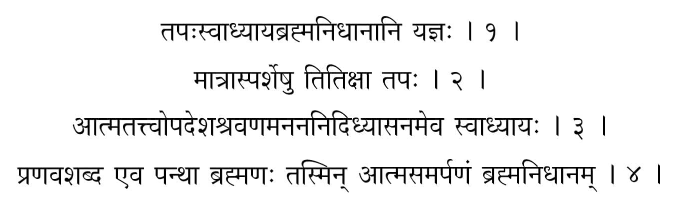
Yajna, sacrifice, means penance (Tapas), deep study (Swadhyaya), and the practice of meditation on Aum (Brahmanidhana).
Penance is patience or evenmindedness in all conditions (equanimity amidst the essential dualities of Maya; cold and heat, pain and pleasure, etc.).
Swadhyaya consists of reading or hearing spiritual truth, pondering it, and forming a definite conception of it.
(Meditation on) Pranava, the divine sound of Aum, is the only way to Brahman (Spirit), salvation.
Patience, faith, and holy work explained. Tapas is religious mortification or patience both in enjoyments and in sufferings. Swadhyaya is sravana, study, with manana, deep attention, and thereby nididhyasana, forming of an idea of the true faith about Self; that is, what I am, whence I came, where I shall go, what I have come for, and other such matters concerning Self. Brahmanidhana is the baptism or merging of Self in the stream of the Holy Sound (Pranava, Aum), which is the holy work performed to attain salvation and the only way by which man can return to his Divinity, the Eternal Father, whence he has fallen. See Revelation 2:19.
I know thy works, and charity, and service, and faith, and thy patience, and thy works; and the last to be more than the first.
Sutra 5, 6
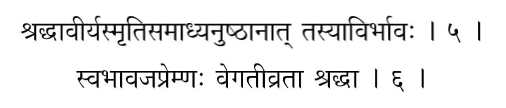
Aum is heard through cultivation of Sraddha (heart's natural love), Virya (moral courage), Smriti (memory of one's divinity), and Samadhi (true concentration).
Sraddha is intensification of the heart's natural love.
How the Holy Sound manifests. This Holy Sound Pranava Sabda manifests spontaneously through culture of Sraddha, the energetic tendency of the heart's natural love; Virya, moral courage; Smriti, true conception; and Samadhi, true concentration.
The virtue of Love. The heart's natural love is the principal requisite to attain a holy life. When this love, the heavenly gift of Nature, appears in the heart, it removes all causes of excitation from the system and cools it down to a perfectly normal state; and, invigorating the vital powers, expels all foreign matters—the germs of diseases—by natural ways (perspiration and so forth). It thereby makes man perfectly healthy in body and mind, and enables him to understand properly the guidance of Nature.
When this love becomes developed in man it makes him able to understand the real position of his own Self as well as of others surrounding him.
With the help of this developed love, man becomes fortunate in gaining the Godlike company of the divine personages and is saved forever. Without this love, man cannot live in the natural way, neither can he keep company with the fit person for his own welfare; he becomes often excited by the foreign matters taken into his system through mistakes in understanding the guidance of Nature, and in consequence he suffers in body and mind. He can never find any peace whatever, and his life becomes a burden. Hence the culture of this love, the heavenly gift, is the principal requisite for the attainment of holy salvation; it is impossible for man to advance a step toward the same without it. See Revelation 2:2–4.
I know thy works, and thy labor, and thy patience, and how thou canst not bear them which are evil: and thou hast tried them which say they are apostles, and are not, and hast found them liars.
And hast borne and hast patience, and for my name's sake hast labored, and hast not fainted.
Nevertheless I have somewhat against thee, because thou hast left thy first love.
Sutra 7, 8
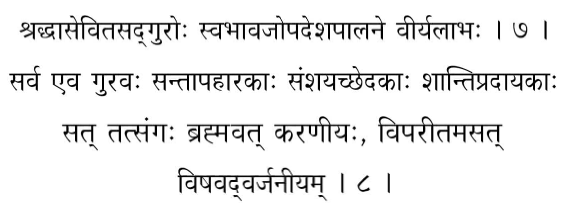
Moral courage (Virya) arises from Sraddha, directing one's love toward the guru, and from affectionately following his instructions.
Those who remove our troubles, dispel our doubts, and bestow peace are true teachers. They perform a Godlike work. Their opposites (those who increase our doubts and difficulties) are harmful to us and should be avoided like poison.
As explained in the previous chapter, this creation is substantially nothing but a mere idea—play of Nature on the only Real Substance, God, the Eternal Father, who is Guru—the Supreme—in this universe. All things of this creation are therefore no other substance than this Guru, the Supreme Father, God Himself, perceived in plurality by the manifold aspects of the play of Nature. See John 10:34 and Psalm (Bible) 82:6.
Jesus answered them, Is it not written in your law, I said, Ye are gods?
I have said, Ye are gods; and all of you are children of the most High.
Out of this creation, the object that relieves us of our miseries and doubts and administers peace to us, whether animate or inanimate, and however insignificant the same may be, is entitled to our utmost respect. Even if it be regarded by others as an object of vilest contempt, it should be accepted as Sat (Saviour) and its company as Godlike. That which produces opposite results, destroying our peace, throwing us into doubts, and creating our miseries, should be considered Asat, the bane of all good, and should be avoided as such. The Indian sages have a saying:
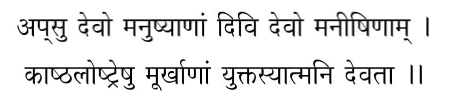
Some consider the deities to exist in water (i.e., natural elements) while the learned consider them to exist in heaven (astral world); the unwise seek them in wood and stones (i.e., in images or symbols), but the Yogi realizes God in the sanctuary of his own Self.
To attain salvation men choose as their Saviour the objects that they can comprehend according to their own stage of evolution. Thus, in general, people think that illness is a dire calamity; and as water, when properly administered, tends to remove illness, ignorant men may choose for their Divinity water itself.
Philosophers, being able to comprehend the internal electrical Light that shines within them, find their heart's love flowing energetically toward the Light that relieves them of all causes of excitation, cools down their system to a normal state, and, invigorating their vital powers, makes them perfectly healthy, both in body and in mind. They then accept this Light as their Divinity or Saviour.
Ignorant people in their blind faith would accept a piece of wood or stone as their Saviour or Divinity in the external creation, for which their heart's natural love will develop till by its energetic tendency it will relieve them of all exciting causes, cool their system down to a normal state, and invigorate their vital powers. The adepts, on the other hand, having full control over the whole material world, find their Divinity or Saviour in Self and not outside in the external world.
Regard the Guru with deep love. To keep company with the Guru is not only to be in his physical presence (as this is sometimes impossible), but mainly means to keep him in our hearts and to be one with him in principle and to attune ourselves with him.
This thought has been expressed by Lord Bacon: A crowd is not a company, it is a mere gallery of faces
. To keep company, therefore, with the Godlike object is to associate him with Sraddha, the heart's love intensified in the sense above explained, by keeping his appearance and attributes fully in mind, and by reflecting on the same and affectionately following his instructions, lamblike. See John 1:29.
Behold the Lamb of God, which taketh away the sin of the world.
By so doing, when man becomes able to conceive the sublime status of his divine brothers, he may be fortunate in remaining in their company and in securing help from any one of them whom he may choose as his Spiritual Preceptor, Sat–Guru, the Saviour.
Thus, to resume, Virya or moral courage can be obtained by the culture of Sraddha, that is, by devoting one's natural love to his Preceptor, by being always in his company (in the internal sense already explained), and by following with affection his holy instructions as they are freely and spontaneously given.
Sutra 9 — 11
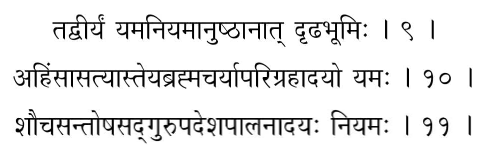
Moral courage is strengthened by observance of Yama (morality or self–control) and Niyama (religious rules).
Yama comprises noninjury to others, truthfulness, nonstealing, continence, and noncovetousness.
Niyama means purity of body and mind, contentment in all circumstances, and obedience (following the instructions of the guru)
Firmness of moral courage can be attained by the culture of Yama, the religious forbearances: abstention from cruelty, dishonesty, covetousness, unnatural living, and unnecessary possessions; and of Niyama, the religious observances: purity in body and mind—cleaning the body externally and internally from all foreign matters which, being fermented, create different sorts of diseases in the system, and clearing the mind from all prejudices and dogmas that make one narrow—contentment in all circumstances; and obedience to the holy precepts of the divine personages.
What is natural living? To understand what natural living is, it will be necessary to distinguish it from what is unnatural. Living depends upon the selection of (1) food, (2) dwelling, and (3) company. To live naturally, the lower animals can select these for themselves by the help of their instincts and the natural sentinels placed at the sensory entrances—the organs of sight, hearing, touch, smell, and taste. With men in general, however, these organs are so much perverted by unnatural living from very infancy that little reliance can be placed on their judgments. To understand, therefore, what our natural needs are, we ought to depend upon observation, experiment, and reason.
What is natural food for man? First, to select our natural food, our observation should be directed to the formation of the organs that aid in digestion and nutrition, the teeth and digestive canal; to the natural tendency of the organs of sense which guide animals to their food; and to the nourishment of the young.
Observation of teeth. By observation of the teeth we find that in carnivorous animals the incisors are little developed, but the canines are of striking length, smooth and pointed, to seize the prey. The molars also are pointed; these points, however, do not meet, but fit closely side by side to separate the muscular fibers.
In the herbivorous animals the incisors are strikingly developed, the canines are stunted (though occasionally developed into weapons, as in elephants), the molars are broad–topped and furnished with enamel on the sides only.
In the frugivorous all the teeth are of nearly the same height; the canines are little projected, conical, and blunt (obviously not intended for seizing prey but for exertion of strength). The molars are broad–topped and furnished at the top with enamel folds to prevent waste caused by their side motion, but not pointed for chewing flesh.
In omnivorous animals such as bears, on the other hand, the incisors resemble those of the herbivorous, the canines are like those of the carnivorous, and the molars are both pointed and broad–topped to serve a twofold purpose.
Now if we observe the formation of the teeth in man we find that they do not resemble those of the carnivorous, neither do they resemble the teeth of the herbivorous or the omnivorous. They do resemble, exactly, those of the frugivorous animals. The reasonable inference, therefore, is that man is a frugivorous or fruit–eating animal*.
* Fruit comprises any part of plant life useful to man. The fruitarian diet referred to by Swami Sri Yukteswar includes vegetables, nuts, and grains. (Publisher's Note)
Observation of the digestive canal. By observation of the digestive canal we find that the bowels of carnivorous animals are 3 to 5 times the length of their body, measuring from the mouth to the anus; and their stomach is almost spherical. The bowels of the herbivorous are 20 to 28 times the length of their body and their stomach is more extended and of compound build. But the bowels of the frugivorous animals are 10 to 12 times the length of their body; their stomach is somewhat broader than that of the carnivorous and has a continuation in the duodenum serving the purpose of a second stomach.
This is exactly the formation we find in human beings, though Anatomy says that the human bowels are 3 to 5 times the length of man's body—making a mistake by measuring the body from the crown to the soles, instead of from mouth to anus. Thus we can again draw the inference that man is, in all probability, a frugivorous animal.
Observation of organs of sense. By observation of the natural tendency of the organs of sense—the guideposts for determining what is nutritious—by which all animals are directed to their food, we find that when the carnivorous animal finds prey, he becomes so much delighted that his eyes begin to sparkle; he boldly seizes the prey and greedily laps the jetting blood. On the contrary, the herbivorous animal refuses even his natural food, leaving it untouched, if it is sprinkled with a little blood. His senses of smell and sight lead him to select grasses and other herbs for his food, which he tastes with delight. Similarly with the frugivorous animals, we find that their senses always direct them to fruits of the trees and field.
In men of all races we find that their senses of smell, sound, and sight never lead them to slaughter animals; on the contrary they cannot bear even the sight of such killings. Slaughterhouses are always recommended to be removed far from the towns; men often pass strict ordinances forbidding the uncovered transportation of flesh meats. Can flesh then be considered the natural food of man, when both his eyes and his nose are so much against it, unless deceived by flavors of spices, salt, and sugar? On the other hand, how delightful do we find the fragrance of fruits, the very sight of which often makes the mouth water! It may also be noticed that various grains and roots possess an agreeable odor and taste, though faint, even when unprepared. Thus again, we are led to infer from these observations that man was intended to be a frugivorous animal*.
*
And God said, Behold, I have given you every herb bearing seed, which is upon the face of all the earth, and every tree, in which is the fruit of a tree yielding seed; to you it shall be for meat. — Genesis 1:29 . (Publisher's Note)
Observation of the nourishment of the young. By observation of the nourishment of the young we find that milk is undoubtedly the food of the newborn babe. Abundant milk is not supplied in the breasts of the mother if she does not take fruits, grains, and vegetables as her natural food.
Cause of disease. Hence from these observations the only conclusion that can reasonably be drawn is that various grains, fruits, roots, and—for beverage—milk, and pure water openly exposed to air and sun are decidedly the best natural food for man. These, being congenial to the system when taken according to the power of the digestive organs, well chewed and mixed with saliva, are always easily assimilated.
Other foods are unnatural to man and being uncongenial to the system are necessarily foreign to it; when they enter the stomach, they are not properly assimilated. Mixed with the blood, they accumulate in the excretory and other organs not properly adapted to them. When they cannot find their way out, they subside in tissue crevices by the law of gravitation; and, being fermented, produce diseases, mental and physical, and ultimately lead to premature death.
Children's development. Experiment also proves that the nonirritant diet natural to the vegetarian is, almost without exception, admirably suited to children's development, both physical and mental. Their minds, understanding, will, the principal faculties, temper, and general disposition are also properly developed.
Natural living calms passions. We find that when extraordinary means such as excessive fasting, scourging, or monastic confinement are resorted to for the purpose of suppressing the sexual passions, these means seldom produce the desired effect. Experiment shows, however, that man can easily overcome these passions, the archenemy of morality, by natural living on a nonirritant diet, above referred to; thereby men gain a calmness of mind which every psychologist knows is the most favourable to mental activity and to a clear understanding, as well as to a judicial way of thinking.
Sexual desire. Something more should be said here about the natural instinct of propagation, which is, next to the instinct of self–preservation, the strongest in the animal body. Sexual desire, like all other desires, has a normal and an abnormal or diseased state, the latter resulting only from the foreign matter accumulated by unnatural living as mentioned above. In the sexual desire everyone has a very accurate thermometer to indicate the condition of his health. This desire is forced from its normal state by the irritation of nerves that results from the pressure of foreign matter accumulated in the system, which pressure is exerted on the sexual apparatus and is at first manifested by an increased sexual desire followed by a gradual decrease of potency.
This sexual desire in its normal state makes man quite free from all disturbing lusts, and operates on the organism (awaking a wish for appeasement) only infrequently. Here again experiment shows that this desire, like all other desires, is always normal in individuals who lead a natural life as mentioned.
The root of the tree of life. The sexual organ—the junction of important nerve extremities, particularly of the sympathetic and spinal nerves (the principal nerves of the abdomen) which, through their connection with the brain, are capable of enlivening the whole system—is in a sense the root of the tree of life. Man well–instructed in the proper use of sex can keep his body and mind in proper health and can live a pleasant life throughout.
The practical principles of sexual health are not taught because the public regards the subject as unclean and indecent. Thus blinded, mankind presumes to clothe Nature in a veil because she seems to them impure, forgetting that she is always clean and that everything impure and improper lies in man's ideas, and not in Nature herself. It is clear therefore that man, not knowing the truth about the dangers of misuse of the sexual power, and being compelled to wrong practices by the nervous irritation resulting from unnatural living, suffers troublesome diseases in life and ultimately becomes a victim of premature death.
Dwelling place of man. Secondly, about our dwelling place. We can easily understand, when we feel displeasure on entering a crowded room after breathing fresh air on a mountaintop or in an expanse of field or garden, that the atmosphere of the town or any crowded place is quite an unnatural dwelling place. The fresh atmosphere of the mountaintop, or of the field or garden, or of a dry place under trees covering a large plot of land and freely ventilated with fresh air is the proper dwelling place for man according to Nature.
The company we should keep. And thirdly, as to the company we should keep. Here also, if we listen to the dictates of our conscience and consult our natural liking, we will at once find that we favour those persons whose magnetism affects us harmoniously, who cool our system, internally invigorate our vitality, develop our natural love, and thus relieve us of our miseries and administer peace to us. This is to say, we should be in the company of the Sat or Saviour and should avoid that of the Asat, as described before. By keeping the company of Sat (the Saviour) we are enabled to enjoy perfect health, physical and mental, and our life is prolonged. If on the other hand we disobey the warning of Mother Nature, without listening to the dictates of our pure conscience, and keep the company of whatever has been designated as Asat, an opposite effect is produced and our health is impaired and our life shortened.
Necessity of natural living and purity. Thus natural living is helpful for the practice of Yama, the ascetic forbearances as explained earlier. Purity of mind and body being equally important in the practice of Niyama, the ascetic observances already explained, every attempt should be made to attain that purity.
Sutra 12 — 18
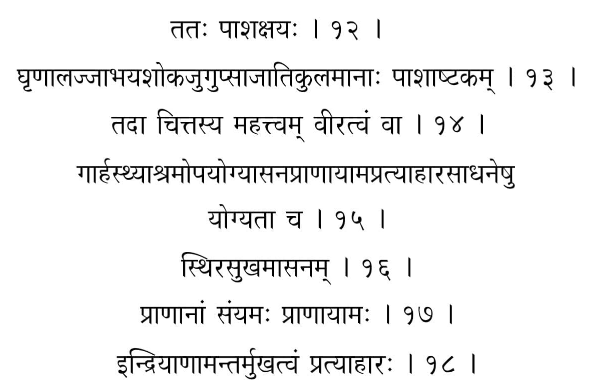
Hence bondage disappears.
The eight bondages or snares are hatred, shame, fear, grief, condemnation, race prejudice, pride of family, and smugness.
(Removal of the eight bondages) leads to magnanimity of heart.
Thus one becomes fit to practice Asana, Pranayama, and Pratyahara; and to enjoy the householder's life (by fulfilling all one's desires and so getting rid of them).
Asana means a steady and pleasant posture of the body.
Pranayama means control over prana, life force.
Pratyahara means withdrawal of the senses from external objects.
The eight meannesses of the heart. Firmness of moral courage, when attained, removes all the obstacles in the way of salvation. These obstacles are of eight sorts—hatred, shame, fear, grief, condemnation, race prejudice, pride of pedigree, and a narrow sense of respectability—which eight are the meannesses of the human heart.
Awakening magnanimity of the heart. By the removal of these eight obstacles, Viratwam or Mahattwam (magnanimity of the heart) comes in, and this makes man fit for the practice of Asana (remaining in steady and pleasant posture), Pranayama (control over prana, involuntary nerve electricities), and Pratyahara (changing the direction of the voluntary nerve currents inward). These practices enable man to satisfy his heart by enjoying the objects of the senses as intended for Garhasthyasrama (domestic) life.
Value of Pranayama. Man can put the voluntary nerves into action whenever he likes, and can give them rest when fatigued. When all of these voluntary nerves require rest he sleeps naturally, and by this sleep the voluntary nerves, being refreshed, can work again with full vigour. Man's involuntary nerves, however, irrespective of his will, are working continuously of themselves from his birth. As he has no control over them, he cannot interfere with their action in the least. When these nerves become fatigued they also want rest and naturally fall asleep. This sleep of the involuntary nerves is called Mahanidra, the great sleep, or death. When this takes place, the circulation, respiration, and other vital functions being stopped, the material body naturally begins to decay. After a while, when this great sleep Mahanidra is over, man awakes, with all his desires, and is reborn in a new physical body for the accomplishment of his various yearnings. In this way man binds himself to life and death and fails to achieve final salvation.
Control over death. But if man can control these involuntary nerves by the aforesaid Pranayama, he can stop the natural decay of the material body and put the involuntary nerves (of the heart, lungs, and other vital organs) to rest periodically, as he does with his voluntary nerves in sleep. After such rest by Pranayama the involuntary nerves become refreshed and work with newly replenished life.
As after sleep, when rest has been taken by the voluntary nerves, man requires no help to awaken naturally; so after death also, when man has enjoyed a full rest, he awakens naturally to life in a new body on earth. If man can die
, that is, consciously put his entire nervous system, voluntary and involuntary, to rest each day by practice of Pranayama, his whole physical system works with great vigour.
Life and death come under the control of the yogi who perseveres in the practice of Pranayama. In that way he saves his body from the premature decay that overtakes most men, and can remain as long as he wishes in his present physical form, thus having time to work out his karma in one body and to fulfil (and so get rid of) all the various desires of his heart. Finally purified, he is no longer required to come again into this world under the influence of Maya, Darkness, or to suffer the second death
. See I Corinthians 15:31, and Revelation 2:10, 11.
I protest by our rejoicing which I have in Christ [consciousness], I die daily.” — St. Paul.
Be thou faithful unto death, and I will give thee a crown of life… He that overcometh shall not be hurt of the second death.
Necessity of Pratyahara. Man enjoys a thing when he so desires. At the time of the enjoyment, however, if he directs his organs of sense, through which he enjoys, toward the object of his desire, he can never be satisfied, and his desires increase in double force. On the contrary, if he can direct his organs of sense inward toward his Self, at that time he can satisfy his heart immediately. So the practice of the aforesaid Pratyahara, the changing of the direction of the voluntary nerve currents inward, is a desirable way to fulfill his worldly desires. Man must reincarnate again and again until all his earthly longings are worked out and he is free from all desires.
Necessity of Asana. Man cannot feel or even think properly when his mind is not in a pleasant state; and the different parts of the human body are so harmoniously arranged that if even any minutest part of it be hurt a little, the whole system becomes disturbed. So to comprehend a thing, that is, to feel a thing by the heart clearly, the practice of the aforesaid Asana, the steady and pleasant posture, is necessary.
Sutra 19 — 22
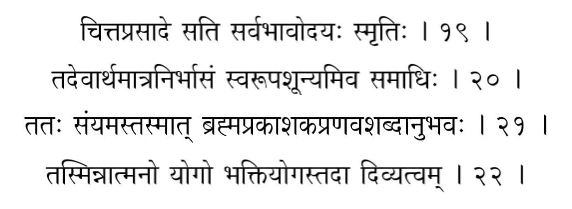
Smriti, true conception, leads to knowledge of all creation.
Samadhi, true concentration, enables one to abandon individuality for universality.
Hence arises Samyama (restraint
or overcoming the egoistic self), by which one experiences
the Aum vibration that reveals God.
Thus the soul (is baptized) in Bhakti Yoga (devotion). This is the state of Divinity.
Smriti, the true conception. Man, when expert in the above–mentioned practices, becomes able to conceive or feel all things of this creation by his heart. This true conception is called Smriti.
Samadhi, true concentration. Fixing attention firmly on any object thus conceived, when man becomes as much identified with it as if he were devoid of his individual nature, he attains the state of Samadhi or true concentration.
Pranava Sabda, the Word of God. When man directs all his organs of sense toward their common center, the sensorium or Sushumnadwara, the door of the internal world, he perceives his God–sent luminous body of Radha or John the Baptist, and hears the peculiar knocking
sound, Pranava Sabda, the Word of God. See John 1:6, 7, 23.
There was a man sent from God, whose name was John.
The same came for a witness, to bear witness of the Light, that all men through him might believe.
I am the voice of one crying in the wilderness.
Samyama, the concentration of the self. Thus perceiving, man naturally believes in the existence of the true Spiritual Light, and, withdrawing his self from the outer world, concentrates himself on the sensorium. This concentration of the self is called Samyama.
Bhakti Yoga or baptism, the second birth of man. By this Samyama or concentration of self on the sensorium, man becomes baptized or absorbed in the holy stream of the Divine Sound. This baptism is called Bhakti Yoga. In this state man repents; that is, turning from this gross material creation of Darkness, Maya, he climbs back toward his Divinity, the Eternal Father, whence he had fallen, and passing through the sensorium, the door, enters into an internal sphere, Bhuvarloka. This entrance into the internal world is the second birth of man. In this state man becomes Devata, a divine being.
Sutra 23
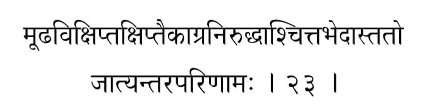
Translation same as following commentary.
Five states of human heart. There are five states of the human heart: dark, propelled, steady, devoted, and clean. By these different states of the heart man is classified, and his evolutionary status determined.
Sutra 24

In the dark state of the heart, man harbours misconceptions (about everything). This state is a result of Avidya, Ignorance, and produces a Sudra (a man of the lowest caste). He can grasp only ideas of the physical world. This state of mind is prevalent in Kali Yuga, the Dark Age of a cycle.
The dark heart. In the dark state of the heart man misconceives; he thinks that this gross material portion of the creation is the only real substance in existence, and that there is nothing besides. However, this is contrary to the truth, as has been explained before, and is nothing but the effect of Ignorance, Avidya.
Sudra or servant class. In this state man is called Sudra, or belonging to the servant class, because his natural duty then is to serve the higher class people in order to secure their company and thereby prepare his heart to attain a higher stage.
Kali Yuga, the dark cycle. This state of man is called Kali; and whenever in any solar system man generally remains in this state and is ordinarily deprived of the power of advancing beyond the same, the whole of that system is said to be in Kali Yuga, the dark cycle.
Sutra 25, 26
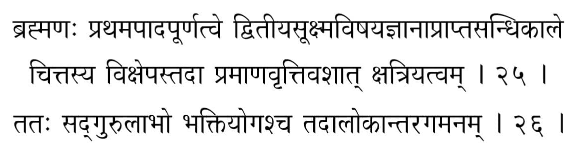
Passing beyond the first stage in Brahma's plan, man strives for enlightenment and enters the natural Kshatriya (warrior) caste.
He is propelled (by evolutionary forces) to struggle (for truth). He seeks a guru and appreciates his divine counsel. Thus a Kshatriya becomes fit to dwell in the worlds of higher understanding.
The propelled heart. When man becomes a little enlightened he compares his experiences relating to the material creation, gathered in his wakeful state, with his experiences in dream, and understanding the latter to be merely ideas, begins to entertain doubts as to the substantial existence of the former. His heart then becomes propelled to learn the real nature of the universe and, struggling to clear his doubts, seeks for evidence to determine what is truth.
Kshatriya, the military class. In this state man is called Kshatriya, or one of the military class; and to struggle in the manner aforesaid becomes his natural duty, by whose performance he may get an insight into the nature of creation and attain the real knowledge of it.
Sandhisthala —the place between higher and lower. This Kshatriya state of man is called Sandhisthala, the place between higher and lower. In this state men, becoming anxious for real knowledge, need help of one another; hence mutual love, the principal necessity for gaining salvation, appears in the heart.
Motivated by the energetic tendency of this love, man affectionately keeps company with those who destroy troubles, clear doubts, and afford peace to him, and hence avoids whatever produces the contrary result; he also studies scientifically the scriptures of divine personages.
When man finds Sat–Guru, the Saviour. In this way man becomes able to appreciate what true faith is, and understands the real position of the divine personages when he is fortunate in securing the Godlike company of some one of them who will kindly stand to him as his Spiritual Preceptor, Sat–Guru, or Saviour. Following affectionately the holy precepts, he learns to concentrate his mind, directing his organs of sense to their common centre or sensorium, Sushumnadwara, the door of the internal sphere. There he perceives the luminous body of John the Baptist, or Radha, and hears the holy Sound (Amen, Aum) like a stream or river; and being absorbed or baptized in it, begins to move back toward his Divinity, the Eternal Father, through the different Lokas or spheres of the creation.
Sutra 27

The worlds or Lokas of creation are seven: Bhu, Bhuvar, Swar,
Mahar, Jana, Tapo, and Satya. (This earth, and the earthy
stage of man's
consciousness, are called Bhuloka.)
The Seven Lokas. In the way toward Divinity there are seven spheres or stages of creation, designated as Swargas or Lokas by the Oriental sages, as described in Chapter 1:13. These are Bhuloka, the sphere of gross matters; Bhuvarloka, the sphere of fine matters or electric attributes; Swarloka, the sphere of magnetic poles and auras or electricities; Maharloka, the sphere of magnets, the atoms; Janaloka, the sphere of Spiritual Reflections, the Sons of God; Tapoloka, the sphere of the Holy Ghost, the Universal Spirit; and Satyaloka, the sphere of God, the Eternal Substance, Sat. Of these seven planes, the first three (Bhuloka, Bhuvarloka, and Swarloka) comprise the material creation, the kingdom of Darkness,
Maya; and the last three (Janaloka, Tapoloka, and Satyaloka) comprise the spiritual creation, the kingdom of Light. Maharloka or the sphere of Atom, being in the midst, is said to be the door
communicating between these two—the material and spiritual creation—and is called Dasamadwara, the tenth door, or
Brahmarandhra, the way to Divinity.
Sutra 28

Entering Bhuvarloka (air
or the world of becoming
) man becomes a Dvija or
twice–born
. He comprehends the second portion of material creation —that of finer, subtler forces. This state
of mind is prevalent in Dwapara Yuga.
Dvija or twice–born. When man, being baptized, begins to repent and move back toward the Eternal Father and, withdrawing his self from the gross material world, Bhuloka, enters into the world of fine matter, Bhuvarloka, he is said to belong to the Dvija or twice–born class. In this state he comprehends his internal electricities, the second fine material portion of the creation; and understands that the existence of the external is substantially nothing but mere coalescence or union of his fine internal objects of sense (the negative attributes of electricities) with his five organs of sense (the positive attributes) through his five organs of action (the neutralizing attributes of the same), caused by the operation of his mind and conscience (consciousness).
The steady heart. This state of man is Dwapara; and when this becomes the general state of human beings naturally in any solar system, the whole of that system is said to be in Dwapara Yuga. In this Dwapara state the heart becomes steady.
If man continues in the baptized state, remaining immersed in the holy stream, he gradually comes to a pleasant state wherein his heart wholly abandons the ideas of the external world and becomes devoted to the internal one.
Sutra 29
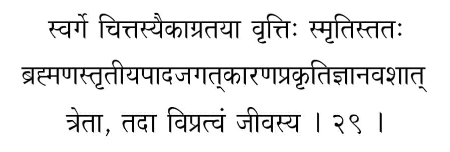
In Swarloka (heaven
) man is fit to understand the mysteries of Chitta, the
magnetic third portion of material creation. He becomes a Vipra (nearly perfect being). This state of mind
is prevalent in Treta Yuga.
The devoted heart. In this devoted state man, withdrawing his self from Bhuvarloka, the world of electric attributes, comes to Swarloka, the world of magnetic attributes, the electricities and poles; he then becomes able to comprehend Chitta, Heart, the magnetic third portion of creation. This Chitta, as explained in Chapter 1, is the spiritualized Atom, Avidya or Ignorance, a part of Darkness, Maya. Man, comprehending this Chitta, becomes able to understand the whole of Darkness, Maya itself, of which Chitta is a part, as well as the entire creation. Man is then said to belong to the Vipra, or nearly perfect, class. This state of human beings is called Treta; when this becomes the general state of human beings naturally in any solar system, the whole of that system is said to be in Treta Yuga.
Sutra 30
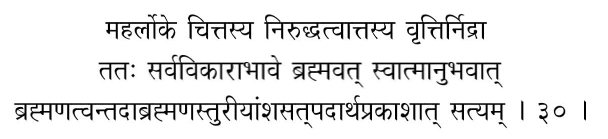
Through true repentance man reaches Maharloka (the great world
). No longer subject to the
influence of ignorance, Maya, he attains a clean heart. He enters the natural caste of the Brahmanas
(knowers of Brahma
). This state of mind is prevalent in Satya Yuga.
The Clean Heart. Man continuing Godward further lifts up his self to Maharloka, the region of magnet, the Atom; then all the developments of Ignorance being withdrawn, his heart comes to a clean state, void of all external ideas. Then man becomes able to comprehend the Spiritual Light, Brahma, the Real Substance in the universe, which is the last and everlasting spiritual portion in creation. In this stage man is called Brahmana or of the spiritual class. This stage of the human being is called Satya, and when this becomes the general state of man naturally in any solar system, the whole of that system is said to be in Satya Yuga.
Sutra 31, 32
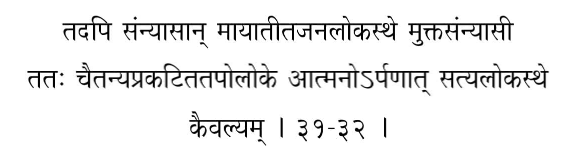
Not merely reflecting but manifesting Spiritual Light, man rises to Janaloka, the kingdom of God.
Then he passes into Tapoloka, the sphere of Kutastha Chaitanya.
Abandoning the vain idea of his separate existence, he enters Satyaloka, wherein he attains the state of final release or Kaivalya, oneness with Spirit.
In this way, when the heart becomes purified, it no longer merely reflects but manifests Spiritual Light, the Son of God; and thus being consecrated or anointed by the Spirit it becomes Christ, the Saviour. This is the only way through which man, being again baptized or absorbed in Spirit, can rise above the creation of Darkness and enter into Janaloka, the Kingdom of God; that is, the creation of Light. In this state man is called Jivanmukta Sannyasi, like Lord Jesus of Nazareth. See John 3:5 and 14:6.
Verily, verily, I say unto thee, Except a man be born of water and of the Spirit, he cannot enter into the kingdom of God.
Jesus saith unto him, I am the way, the truth, and the life: no man cometh unto the Father, but by me.
In this state man comprehends himself as nothing but a mere ephemeral idea resting on a fragment of the universal Holy Spirit of God, the Eternal Father, and understanding the real worship, he sacrifices his self there at this Holy Spirit, the altar of God; that is, abandoning the vain idea of his separate existence, he becomes dead
or dissolved in the universal Holy Spirit; and thus reaches Tapoloka, the region of the Holy Ghost.
In this manner, being one and the same with the universal Holy Spirit of God, man becomes unified with the Eternal Father Himself, and so comes to Satyaloka, in which he comprehends that all this creation is substantially nothing but a mere idea—play of his own nature, and that nothing in the universe exists besides his own Self. This state of unification is called Kaivalya, the Sole Self. See Revelation 14:13 and John 16:28.
Blessed are the dead which die in the Lord from henceforth.
I came forth from the Father; and am come into the world: again, I leave the world, and go to the Father.

Chapters
| Holy Science: ForewordProphets nirbikalpa samadhi revelations Jnanavatar Babaji Lahiri Mahasaya Bhagavad Gita samkhya sankhya foreword |
| Holy Science: Prefacepreface tibetan yoga |
| Holy Science: Introductionintroduction giri yuga diagram Babaji mountain Prayaga Tirtha Ganges Yamuna Saraswati Kumbha Mela Tirtha Vishnunabhi sadhus Atmajnanam self knowledge veda gospel yuga Dwapara Yuga Brahma dharma Autumnal Equinox Aries Virgo pisces Vernal Equinox Piscean Age Aquarius leo Libra Daiva Yugas Electric Couple Kali Yuga Treta Yuga Satya Yuga Manu rishi Krita Yuga sandhis Yugasandhis Sukshmabhuta panchatanmatra electricity Sir Isaac Newton Gilbert Kepler Pranava aum Kulluka Bhatta Raja Parikshit Maharaja Yudhisthira Himalaya datva daiva Revati magnetism auras five sensory nerves Raja Vikramaditya Samvat |
| Holy Science: Chapter 1 The Gospelsutras god Swami Parambrahma Maya satchitananda Prakriti Shakti Vasana Bhoga Omniscient Consciousness Chetana Bhokta Genesis Omnipotent kala desa anu Atom Word Time Space patra Revelation john Amen god Kutastha Chaitanya holy ghost Purushottama Premabijam Chit Abhasa Chaitanya Purusha Buddhi Ahamkara Manas Chitta Kshiti Tejas Marut Vyoma Akasha Sthulasarira Swargas Satyaloka Anama Tapoloka Maharloka Alakshya Dasamadwara Mahasunya Bhuvarloka Bhuloka sapta Patalas Bhuvanas koshas Bhakti Sushumnadwara Parokshajnana Radha Trikuti Kaivalya Christ Consciousness Abhasa Chaitanya Sannyasi |
| Holy Science: Chapter 2 The Goalsutras maya evil Purusha jiva liberation soul Avidya ignorance Abhinivesa tenacity Asmita ego Raga attachment Dwesha aversion Artha suffering Paramartha the ultimate goal Existence consciousness and bliss sat chitananda satguru sat-guru |
| Holy Science: Chapter 3 The Proceduresutras maya Yajna sacrifice penance Tapas deep study Swadhyaya meditation aum Brahmanidhana Swadhyaya Pranava Brahman spirit salvation sravana manana Virya Sraddha Samadhi Smriti love concentration Pranava Sabda satchitananda sat-guru moral courage true conception Yama morality Niyama religious rules Niyama sexual desire natural living teeth organs food chikdren disease diet omnivore carnivoe herbivore fruitarian Asat Asana pranayama Pratyahara withdrawal of senses Viratwam Mahattwam Garhasthyasrama nerves Samyama john the baptist Bhuvarloka Devata Avidya sudra Kshatriya Radha Sushumnadwara Lokas Swargas Janaloka Tapoloka Satyaloka Dasamadwara Dwapara Yuga Dvija Vipra Chitta Treta Yuga Maharloka Brahmana Kaivalya |
| Holy Science: Chapter 4 The Revelationsutras maya mantras Pranava aum Chitta sadhana Pravartaka sat-guru Pravritti Pravartaka Yama Niyama Sadhaka Siddha Sabda Patala Lokas rishis Bhakti Yoga Surat Sabda Yoga Bhuloka Bhuvarloka ajna chakra sahasrara vishuddha anahata seven centres seven churches seven chakras swadhishthana manipura Surat Sabda Yoga Swarloka Swargas manus Maharloka Avidya manava Maharloka Brahmarandhra Dasamadwara aiswaryas Anima Mahima Laghima Garima Prapti Vasitwa Prakamya mahat laghu apti guru vasa kama Isa aiswaryas Kaivalya discipline |
| Holy Science: Conclusionconclusion lotus love |
| Holy Science: About The Authorabout rishi Serampore calculatta Jnanavatar death yogananda self realization fellowship discipline |
The Real Yoga
website is designed to be a self–study website. But, feel free
to send us a message — but do make sure your email is correct.