














 IndexIntroPosesChairSimple 1Simple 2Simple 3Simple 4Simple 5Simple 6Simple 7Simple 8BasicLesson #1Lesson #2Lesson #3Lesson #4Lesson #5Theory 1Theory 2Theory 3Theory 4Theory 5Theory 6Theory 7Theory 8Theory 9Theory 10Theory 11Theory 12Theory 13Theory 14Theory 15Theory 16Theory 17Theory 18Theory 19Theory 20Theory 21Theory 22Theory 23Theory 24Theory 25Theory 26Theory 27Theory 28Theory 29Theory 30Theory 31Theory 32Theory 33
Chapter 5
Hatha Yoga
Or The Yogi Philosophy Of Physical Well–Being
by Yogi Ramacharaka (1904).
Yogi Ramacharaka wrote more than 100 books in the last 30 years of his life. He shared pure, sincere and
genuine knowledge. This is Real Yoga
.
How many things mentioned in this book do you do intuitively? A pure 1, that is, a person with a 1 soul and a balanced name, is more likely to be intuitively following the lessons within this book.
This book was originally published in 1904 and thus is in the public domain.
The Laboratory Of The Body
This little book is not intended for a text–book upon physiology, but inasmuch as the majority of people seem to have little or no idea of the nature, functions and uses of the various bodily organs, we think it as well to say a few words regarding the very important organs of the body which have to do with the digestion and assimilation of the food which nourishes the body— which perform the laboratory work of the system.
The first hit of the human machinery of digestion to be considered by us are the teeth. Nature has provided us with teeth to bite our food and grind it into fine hits, thus rendering it of a convenient size and consistency to be easily acted upon by the saliva and the digestive juices of the stomach, after which it is reduced to a liquid form that its nourishing qualities may be easily assimilated and absorbed by the body. This seems to be merely a repetition of an oft–told tale, hut how many of our readers really act as if they knew for what purpose their teeth had been given them? They bolt their food just as if teeth were merely for show and generally act as if Nature had provided them with a gizzard, by the aid of which they could like the fowl grind up and break into small bits the food that they had bolted. Remember friends that your teeth were given you for a purpose, and also consider the fact that if Nature had intended you to bolt your food she would have provided you with a gizzard instead of with teeth. We will have much to say about the proper use of the teeth, as we go along, as it has a very close connection with a vital principle of Hatha Yoga, as you will see after a while.
The next organs to be considered are the Salivary Glands. These glands are six in number, of which four are located under the tongue and jaw, and two in the cheeks in the front of the ears, one on each side. Their best known function is to manufacture, generate or secrete saliva, which, when needed, flows out through numerous ducts in different parts of the mouth, and mixes with the food which is being chewed or masticated. The food being chewed into small particles, the saliva is able to more thoroughly reach all portions of it with a correspondingly increased effect. The saliva moistens the food, thus allowing it to he more easily swallowed, this function, however, being a mere incident to its more important ones. Its best known function (and the one which Western science teaches is its most important one) is its chemical offices, which convert the starchy food matter into sugar, thus performing the first step in the process of digestion.
Here is another oft–told tale. You all know about the saliva, but how many of you eat in a manner which allows Nature to put the saliva to work as she had designed? You bolt your food after a few perfunctory chews and defeat Nature's plans, toward which she has gone to so much trouble, and to perform which she has built such beautiful and delicate machinery. But Nature manages to get back
at you for your contempt and disregard of her plans— Nature has a good memory and always make you pay your debts.
We must not forget to mention the tongue— that faithful friend who is so often made to perform the ignoble task of assisting in the utterance of angry words, retailing of gossip, lying, nagging, swearing, and last but not least, complaining.
The tongue has a most important work to perform in the process of nourishing the body with food. Besides a number of mechanical movements which it performs in eating, in which it helps to move the food along and its similar service in the act of swallowing, it is the organ of taste and passes critical judgment upon the food which asks admittance to the stomach.
You have neglected the normal uses of the teeth, the salivary glands and the tongue, and they have consequently failed to give you the best service. If you but trust them and return to sane and normal methods of eating you will find them gladly and cheerfully responding to your trust and will once more give you their full share of service. They are good friends and servants, hut need a little confidence, trust and responsibility to bring out their best points.
After the food has been chewed or masticated and then saturated with saliva it passes down the throat into the stomach. The lower part of the throat, which is called the gullet, performs a peculiar muscular contraction, which pushes downward the particles of food, which act forms a part of the process of swallowing.
The process of converting the starchy portion of the food into sugar, or glucose, which is begun by the saliva in the mouth, is continued as the food passes into and down the gullet, but nearly, or entirely ceases, when the food once reaches the stomach, which fact must be considered when one studies the subject of the advantage of a deliberate habit of eating, as, if the food is hastily chewed and swallowed, it reaches the stomach only partially affected by the saliva and in an imperfect condition for Nature's subsequent work.
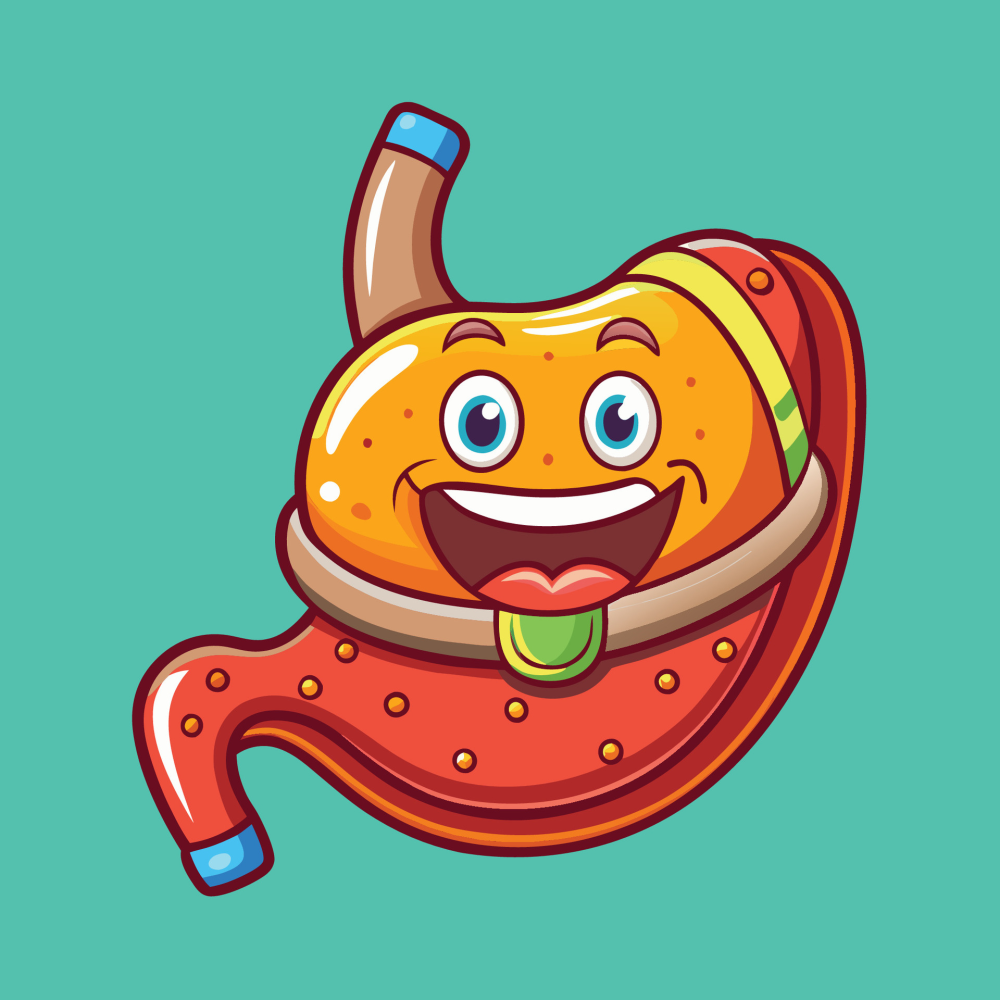
The stomach itself is a pear–shaped bag with a capacity of about one quart or more in some cases. The food enters the stomach from the gullet on the upper left–hand side, just below the heart. The food afterwards leaves the stomach on the lower right–hand and enters the small intestine by means of a peculiar sort of valve, which is so wonderfully constructed that it allows the matter from the stomach to pass easily through it, but refuses to allow anything to work back from the intestine into the stomach. This valve is known as the Pyloric Valve
or the Pyloric Orifice
, the word Pyloric
being derived from the Greek word which means gatekeeper
— and indeed this little valve acts as a most intelligent gatekeeper, always on the watch, never asleep.
The stomach is a great chemical laboratory in which the food undergoes chemical changes which allow it to he taken up by the system and changed into a nourishing material which is converted into rich, red blood which courses all over the body, building up, repairing, strengthening and adding to all the parts and organs.
The inside
of the stomach is covered with a lining of delicate mucous membrane, which is filled with minute glands, all of which open into the stomach and around which is a very fine network of minute blood–vessels with remarkably thin walls, from which is manufactured, or secreted, that wonderful fluid, the gastric juice. The gastric juice is a powerful liquid acting as a solvent upon what is called the nitrogenous portions of the food. It also acts upon the sugar or glucose which has been manufactured from the starchy food by the saliva, as above described. It is a bitter sort of liquid, containing a chemical product called pepsin, which is its active agent and which plays a most important part in the digestion of the food.
In a normal, healthy person the stomach manufactures or secretes about one gallon of gastric juice in twenty–four hours, and uses same in the process of digestion of the food. When the food reaches the stomach the little glands, before mentioned, pour out a sufficient supply of the gastric juice, which mixes up with the mass of food in the stomach. Then the stomach sets up sort of a churning motion, which moves the pulpy food round and round, from end to end, from side to side, twisting and turning it, churning and kneading it, until the gastric juice penetrates every part of the mass and is well mixed up into it. The Instinctive Mind does some wonderful work in the stomach movements and works like a well oiled machine.
And if the stomach has been treated to properly prepared, well chewed food, properly insalivated, the machine is able to turn out a fine job. But if, as so often happens, the food is of a quality not fit for the human stomach— or if it has been but half chewed, or bolted— or if the stomach has been stuffed
by a gluttonous owner— there is going to be trouble. In
such a case, instead of the normal process of digestion being performed, the stomach is unable to do its work and fermentation results, and the stomach becomes the holder of a fermenting, putrefying, rotting mass— an yeast pot
it has been called under such circumstances. If people could but form an idea of what a cesspool they maintain in their stomachs they would cease to shrug their shoulders and look bored whenever the subject of rational and sane habits of eating are mentioned.
This putrefying ferment, arising from abnormal habits of eating, often becomes chronic and results in a condition which manifests itself in the symptoms of what is called dyspepsia
, or similar troubles. It re mains in the stomach for a long time after the meal, and then when the next meal reaches the stomach the fermentation continues until the stomach actually becomes a perpetually active yeast pot
. This condition, of course, results in an impairment of the normal functioning of the stomach, the surface of which becomes slimy, soft, thin and weak. The glands become clogged and the whole digestive apparatus of the stomach becomes impaired and broken down. In such event the half digested food passes out into the small intestine, tainted with the acids arising from fermentation, and the result is that the whole system becomes gradually poisoned and imperfectly nourished.
The food–mass, saturated with the gastric juice which has been poured upon it and kneaded and churned into it, leaves the stomach by the Pyloric orifice on the lower right–hand side of the stomach and enters the small intestine.
The small intestine is a tube–like canal ingeniously coiled upon itself so as to occupy but a comparatively small space, but which is really from twenty to thirty feet in length. Its inner walls are lined with a velvety substance, and through the greater part of its length this velvety lining is arranged in transverse shelf–like folds, which maintain a sort of winking
motion, swaying backward and forward in the intestinal fluids, retarding the passage of the food and providing an increased surface for secretion and absorption. The velvety condition of this mucous lining is caused by numerous minute elevations something like the surface of a piece of plush, which are known as the intestinal villi,
the office of which will be explained a little further on.
As soon as the food–mass enters the small intestine it is met with a peculiar fluid called the bile, which saturates it and is thoroughly mixed up with it. The bile is a secretion of the liver and is stored up ready for use in a strong bag, known as the gall bladder. About two quarts of bile per day is used in saturating the food as it passes into the small intestine. Its purpose is to assist the pancreatic juice in preparing the fatty parts of the food for absorption and also to aid in the prevention of decomposition and putrefaction of the food as it passes through the small intestine and the neutralization of the gastric juice which has already performed its work. The pancreatic juice is secreted by the pancreas, an elongated organ situated just behind the stomach, and its purpose is to act upon the fatty portions of the food and to render them possible of absorption from the intestines along with the other parts of the food nourishment. About one and one–half pints is used daily in this work.
The hundreds of thousands of plush–like hairs
upon the velvety lining of the small intestine (above alluded to), and which are known as villi
, maintain a constant waving motion, passing through and in the soft, semi–liquid food which is passing through the small intestine. They are constantly in motion, licking up and absorbing the nourishment that is contained in the food–mass and transmitting it to the system.
The several steps whereby the food is converted into blood and is carried to all parts of the system are as follows: Mastication, insalivation, deglutition, stomach and intestinal digestion, absorption, circulation and assimilation. Let us run over them again hastily that we may not forget them.
Mastication is performed by the teeth — it is the chewing process — the lips, tongue and cheeks assisting in the work. It breaks up the food into small particles and enables the saliva to reach it more thoroughly.
Insalivation is the process of saturating the masticated food with the saliva which pours into it from the salivary glands. The saliva acts upon the cooked starch in the food, changing it into dextrine and then into glucose, thus rendering it soluble. This chemical change is rendered possible by the action of the pytaline in the saliva acting as a ferment and changing the chemical constitution of those substances for which it has an affinity.
Digestion is performed in the stomach and small intestines and consists in the conversion of the food–mass into products capable of being absorbed and assimilated. Digestion begins when the food reaches the stomach. The gastric juice then pours out copiously, and, becoming mixed up with and churned into the food mass, it dissolves the connective tissue of meat, releases fat from its envelopes by breaking them up and transforms some of the albuminous material, such as lean meat, the gluten of wheat and white of eggs, into albuminose, in which form they are capable of being absorbed and assimilated. The transformation occasioned by stomach digestion is accomplished by the chemical action of an organic ingredient of the gastric juice, called pepsin, in connection with the acid ingredients of the gastric juice.
While the process of digestion is being performed by the stomach the fluid portion of the food–mass, both that which has entered the stomach as fluids which have been drunken, as well as the fluids liberated from the solid food in the process of digestion, is rapidly taken up by the absorbents of the stomach and is carried to the blood, while the more solid portions of the food–mass are churned up by he muscular action of the stomach, as we have stated. In about a half–hour the solid portions of the food–mass begin slowly to leave the stomach in the form of a grayish, pasty substance, called chyme, which is a mixture of some of the sugar and salts of the food, of transformed starch or glucose, of softened starch, of broken fat and connective tissue, and of albuminose.
The Chyme leaving the stomach, enters the small intestine, as we have described and conies in contact with the pancreatic and intestinal juices and with the bile, and intestinal digestion ensues. These fluids dissolve most of the food that has not already been softened. Intestinal digestion resolves the chyme into three substances, known as (i) Peptone, from the digestion of albuminous particles; (2) Chyle, from the emulsion of the fats; (3) Glucose, from the transformation of the starchy elements of the food. These substances are, to a large extent, carried into the blood and become a part of it, while the undigested food passes out of the small intestine through a trap–door–like valve into the large bowel called the colon. of which we shall speak bye–and–bye.
Absorption, by which name is known the process by which the above–named products of the food, resulting from the digestive process, are taken tip by the veins and lacteals, is effected by endosmosis. The water and the fluids liberated from the food–mass by the stomach digestion are rapidly absorbed and carried away by the blood in the portal vein to the liver. The peptone and glucose from the small intestines also reaches the portal vein to the liver through the blood vessels of the intestinal villi, which we have described. This blood reaches the heart after passing through the liver, where it undergoes a process which we will speak of when we reach the subject of the liver. The chyle, which is the remaining product of the food—mass in the intestines after the peptone and glucose have been taken up and carried to the liver, is taken up and passes through the lacteals into the thoracic duct, and is gradually conveyed to the blood, as will be further described in our chapter on the Circulation. In our chapter on the circulation we will explain how the blood carries the nutriment derived from the digested food to all parts of the body, giving to each tissue, cell, organ and part the material by which it builds up and repairs itself, thus enabling the body to grow and develop.
The liver secretes the bile, which is carried to the small intestine, as we have stated. It also stores up a substance called glycogen, which is formed in the liver from the digested materials brought to it by the portal vein (as above explained). Glycogen is stored up in the liver, and is afterwards gradually transformed, in the intervals of digestion, into glucose or a substance similar to grape sugar. The pancreas secretes the pancreatic juices, which it pours into the small intestine, to aid in intestinal digestion, where it acts chiefly upon the fatty portions of the food. The kidneys are located in the loins, behind the intestines. They are two in number and are shaped like beans. They purify the blood by removing from it a poisonous substance called urea and other waste products. The fluid secreted by the kidneys is carried by two tubes, called ureters, to the bladder. The bladder is located in the pelvis and serves as a reservoir for the urine, which consists of waste fluids carrying with it refuse matter of the system.
Before leaving this part of the subject we wish to call the attention of our readers to the fact that when the food enters the stomach and small intestines improperly masticated and insalivated— when the teeth and salivary glands have not been given a chance to do their work properly— digestion is interfered with and impeded and the digestive organs are overworked and are rendered unable to accomplish what is asked of them. It is like asking one set of workmen to do their own work in addition to the work which should have been previously performed by another set of men— it is asking the railroad engineer to perform the duties of firemen as well as his own— to keep the fire going on an up grade and run the locomotive on a dangerous bit of road at the same time. The absorbents of the stomach and intestines must absorb something — that is their business — and if you do not give them the proper materials they will absorb the fermenting and putrefying mass in the stomach and pass it along to the blood The blood carries this poor material to all parts of the body, including the brain, and it is no wonder that people complain of biliousness, headache, etc., when they are being self–poisoned in this way.
Chapters
| Theory Chapter 1: What is Hatha Yoga?fakir raja karma gnana gnani jnana jnani chapter 1 |
| Theory Chapter 2: The Yogis' Regard For The Physical Bodyego conscientiously exercise western |
| Theory Chapter 3: The Work Of The Divine Architect |
| Theory Chapter 4: Our Friend, The Vital Forceprana chi |
| Theory Chapter 5: The Laboratory Of The Bodyteeth tongue saliva glands digestion stomach small intestine Pyloric Valve Pyloric Orifice gastric juice pesin fermentation yeast putrefy dyspepsia villi bile liver pancreatic juice Mastication insalivation deglutition intestinal digestion absorption circulation assimilation chyme Peptone Chyle heart glycogen kidneys urea waste ureters bladder pelvis urine headache poison |
| Theory Chapter 6: The Life Fluidblood nutrition digestion circulation heart capillaries intestinal villi veins lungs lymphatic system chyle brain impurities |
| Theory Chapter 7: The Crematory Of The Systemlungs thorax respiratory heart blood bronchi arteries breathe breathing nose pharynx larynx windpipe trachea chest diaphragm oxygen hemoglobin bronchial tubes |
| Theory Chapter 8: Nourishmentnourishment food |
| Theory Chapter 9: Hunger vs. Appetitenarcotics drugs tobacco wealthy people who were shipwrecked craving starvation alcohol whiskey |
| Theory Chapter 10: The Yogi Theory And Practice Of Prana Absorption From FoodHorace Fletcher American writer magnetism magnetic food eating |
| Theory Chapter 11: About Food |
| Theory Chapter 12: The Irrigation Of The Bodywater sweat perspiration skin kidneys lungs urine constipation colon large intestines small intestines saliva bowels bile colon prana pancreatic juice gastric juices |
| Theory Chapter 13: The Ashes Of The Systemcolon constipation small intestines appendix appendicitis Sigmoid Flexure fecal matter dyspepsia biliousness liver troubles kidney troubles |
| Theory Chapter 14: Yogi Breathingpranayama triple breath Complete Breath |
| Theory Chapter 15: Effects Of Correct Breathingpranayama triple breath Complete Breath |
| Theory Chapter 16: Breathing Exercisespranayama cleansing breath Yogi Nerve Vitalizing Exercise Yogi Vocal Breath The Retained Breath Lung Cell Stimulation Rib Stretching Chest Expansion Walking Exercise Morning Exercise Stimulating Circulation lungs muscles ligaments air cells |
| Theory Chapter 17: Nostril Breathing vs. Mouth Breathingpranayama nose |
| Theory Chapter 18: The Little Lives Of The Bodyboils pimples cells red blood red-blood gastric juice saliva pancreatic juices bile wound healing Instinctive Mind prana |
| Theory Chapter 19: The Control Of The Involuntary Systemprana colon heart liver cold feet menstruation circulation |
| Theory Chapter 20: Pranic Energyprana esoteric exoteric Nervous System Cerebro Spinal System Sympathetic System Medulla Oblongata brain mind Ganglia solar plexus Abdominal Brain manipua third chakra 3rd chakra |
| Theory Chapter 21: Pranic ExercisesPrana Generating Changing The Circulation Recharging Brain Stimulation Yogi Grand Psychic Breath heart Rhythmic Breathing grand breath |
| Theory Chapter 22: The Science Of Relaxationprana muscles instinctive mind cat panther |
| Theory Chapter 23: Rules For Relaxationprana muscles nerves anger worry anxiety stress fear smile smiling calmness stretching poses postures asanas healing health |
| Theory Chapter 24: The Use Of Physical Exerciseprana mental |
| Theory Chapter 25: The Use Of Physical Exercisefat muscles stomach shoulders arms legs back thighs abdomen |
| Theory Chapter 26: The Yogi Bathperspiration japanese pores skin waste sweat kidneys bacteria germs foot bath sleep prana Exercise To Reduce The Abdomen flat stomach standing walking posture slouching |
| Theory Chapter 27: The Solar Energyprana sunbath sun bath planets vitality morning sun |
| Theory Chapter 28: Fresh Airprana lungs kidneys colon bowels skin sleep |
| Theory Chapter 29: Sleepfresh air relaxation |
| Theory Chapter 30: Regenerationprana sex solar plexus kama sutra |
| Theory Chapter 31: The Mental Attitudecheerful happy happiness gloom worry fear hate jealousy anger depressing depression anxiety poison water mothers milk negative thinking positive thinking grief diabetes cancer grief jaundice insanity idiocy paralysis jaundice premature greyness baldness decay of the teeth uterine troubles erysipelas eczema impetigo contagious diseases bright cheerful happy calmness peace strength absolute fearlessness stop and smell the roses |
| Theory Chapter 32: Lead By The Spiritinstinct intuition |
| Hatha Yoga Todayvaccines health geo-engineering climate change holistic health natural health wifi emf celtic salt circadian rhythm |
Send Message
The Real Yoga
website is designed to be a self–study website. But, feel free
to send us a message — but do make sure your email is correct.
Respecting Your Privacy
No spying. No cookies. No Google. No advertising. No tracking. No joking — well, maybe a few jokes.
Say yes to 100% free! Two thumbs up!









IndexIntroPosesChairSimple 1Simple 2Simple 3Simple 4Simple 5Simple 6Simple 7Simple 8BasicLesson #1Lesson #2Lesson #3Lesson #4Lesson #5Theory 1Theory 2Theory 3Theory 4Theory 5Theory 6Theory 7Theory 8Theory 9Theory 10Theory 11Theory 12Theory 13Theory 14Theory 15Theory 16Theory 17Theory 18Theory 19Theory 20Theory 21Theory 22Theory 23Theory 24Theory 25Theory 26Theory 27Theory 28Theory 29Theory 30Theory 31Theory 32Theory 33Order In Chaos